
Friday, August 7, 2009

Where do Writers Get Their Ideas?


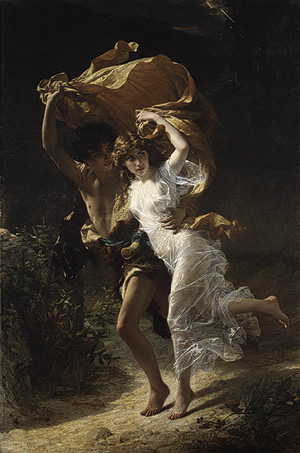
"The Storm"
Pierre-Auguste Cot, oil on canvas, 1880
Metropolitan Museum of Art, New York, New York

According to a note in a collection of Cordwainer Smith stories, that painting is the inspiration of a scene in Alpha Ralpha Boulevard 1 That's likely enough.

Where Do They Get Those Ideas?

I don't think that there's some mystic way that writers get their ideas. I do think that there may be as many ways to get ideas as there are writers: but that they can be put into a manageable number of categories.

This isn't going to be a exhaustive list, but it might help suggest ways to shake story ideas loose.

Visual Art

According to J. J. Pierce, one scene in a Cordwainer Smith story was inspired by that painting. Paintings, photographs, any sort of visual art - representational or not - could suggest a scene or setting or maybe an entire story.

The Heilbrunn Timeline of Art History at the New York Metropolitan Museum is one place to start looking for useful images.

The work at right, by a Chinese artist, has a very specific history (and poem) that goes with it - but might suggest a thousand others.

These examples are fairly representational, but I think that contemplating abstract or other 'unrealistic' work might pry an idea or two loose from your mind.

The News

Good news: What you get in the news are the stories that editors decided might be interesting enough to grab the attention of their readers. You don't have to wonder quite so much, whether or not people would find the situation interesting.

Bad news: these are (with a few embarrassing exceptions) factual accounts of what happened to real people. If you don't change the situation enough, you could be in legal trouble. Besides, someone's going to catch on - and 'pop' goes your credibility as a writer. My opinion.

Other Stories

Same comments.

Booze, Drugs, Severe Head Injury

Interestingly, I'm not aware of anybody romanticizing severe head trauma as a means of artistic release: although it would involve the same principle of boozing or 'expanding your consciousness' with drugs. The human brain, when damaged or impared, can do very strange things to a person's perceptions.

A word of advice, for anyone thinking of re-enacting the sixties: Don't

Sure, after a few beers you may think you're unusually poetic and creative - as well as being exceptionally athletic and attractive. Anyone who's been in a bar before closing time - sober - could confirm that subjective awareness and objective reality aren't necessarily on the same page.

Like the guy at the bar. He'd down a drink, open his wallet and look in it, and order another drink. After a while the bartender asked him what he was doing. The guy showed the bartender a photo of his mother-in-law and said, "when she starts looking good, I've had enough."

Which leads, sort of, into another source for story ideas.

Actually, it's the only source.

Story Ideas: They're All in Your Head

Every method I've suggested - including reading the news - draws on the same source for story ideas. Your own memory and associations you've made between events and ideas.

It's a matter of learning how to get at the storehouse of imagery, events, experiences, and ideas that's already in your head. There, you're on your own.

I don't have much trouble getting images and associations released from whatever psychobabble for 'the unconscious' is these days. All I have to do is release the brake, and enjoy the ride. My problem is making sense of what goes past. One of my blogs, Narcissus-X is a pretty good reflection of the more conventionally 'artistic' content I collect that way.

Although there's more of that angsty artist in me than I like, that's not the sort of stuff I want to produce.

Getting Ideas is One Thing - - -

Finally, there's more to writing than nifty ideas. As I mentioned in a few days ago, written stories are over four thousand years old: and there's excellent reason to think that story-telling goes much further back than than. I suppose it's possible that there's a basic idea for a story that hasn't been used yet: but it's very, very unlikely.

So, I wouldn't worry too much about getting an 'original' idea. The trick is to find an idea that works for a story - and weaving a new narrative around it. (No, I didn't come up with that idea either.)
1Page 259, "The Best of Cordwainer Smith"
Edited, with Introduction and Notes, by J. J. Pierce © 1975 Nelson Doubleday, Inc., Garden City, New York

More-or-less related posts, from Apathetic Lemming of the North:

Monday, August 3, 2009

Four Millennia of Human Nature: I Think Qoheleth is Right

Cuneiform writing is one of the oldest information storage and retrieval technologies we know of - apart from artwork left of cave walls tens of thousands of years ago. Cuneiform made it possible to record data without relying on the memory of human beings: a breakthrough in information technology.

That was about 5,000 years ago.

Roughly 4,100 years back, someone wrote the Epic of Gilgamesh. It's almost certain that the story dates from an earlier period. We don't know about earlier versions, because they most likely were part of an oral tradition: and left no permanent record.

There was a real Gilgamesh, who lived about six centuries before the story was written. I'm not so much concerned with the historical king of Uruk as I am of the character in the story.

The Epic of Gilgamesh and the Human Condition

The title character in the Epic of Gilgamesh is rather larger-than-life: one of the sort of King Arthur/Robin Hood/Luke Skywalker types that 'serious' writers are supposed to disdain. Which is another topic.

I am not doing justice to the story, but a short-short-condensed version is this: Gilgamesh starts out as a young and powerful ruler, and an oppressive one; Anu, one of the gods, creates a sort of counterweight for Gilgamesh - Enkidu; Gilgamesh and Enkidu become friends, and Enkidu dies.

This is where it gets interesting, I think. Gilgamesh is grief-stricken at the death of his friend, and lets his life collapse. He's realized that, like Enkidu, he will die, too.

By overcoming enormous obstacles, Gilgamesh gains access to immortality: and loses it. He gains the power to become young again: and loses it.

Gilgamesh returns to his city, perhaps wiser.

Perfected Human Nature? Don't Hold Your Breath

There's a sort of science fiction story where all of humanity's ills are solved - generally by a combination of psychology, eugenics, and big machines. They've given way to the sort of post-apocalyptic dystopian story I mentioned in yesterday's post. I'm willing to recognize the potential for literary worth in either sort of story: but I'd rather do something I can regard as a bit more plausible.

Judging from the glimpse of the human experience we get in the Epic of Gilgamesh, and other ancient writings, I think it's safe to say that, when it comes to people:
"What has been, that will be; what has been done, that will be done. Nothing is new under the sun."
"Ecclesiastes," 1:9
That's not as hopeless as it sounds.

It's getting late, and I need (desperately) sleep. I'll have to pick this topic up on another day.

More-or-less-related posts: Background:

Sunday, August 2, 2009

"The Future, Far as Human Eye Could See" - Hollerith Cards and Anachronisms

Science fiction, or speculative fiction, Buck Rodgers and Flash Gordon notwithstanding, doesn't always deal with The Future. But quite a bit does.

Including a set of stories I'm hoping to create.

Writers haven't had to think very hard about what The Future (capitalized) would be like, provided that they didn't mind using off-the-shelf settings. During the 20th century, The Future would be filled with gigantic buildings and sweeping elevated roadways with no obvious entrances or exits, electric biplanes and spaceships held together with huge rivets.

Later, a more (sophisticated?) standard-issue vision of the future was a post-(nuclear, bio-weapons, whatever)-apocalyptic wasteland that bore a remarkable similarity to parts of the American southwest and southern California: inhabited by desperate nomads in leather underwear and/or Rambo-styled costumes, mutant frogs, mutant people, mutant things. You get the picture.

Entertaining (or, if required, relevant) stories could be set in variations on any of these.

My intention is to be a trifle more imaginative than that.

By the way, if this post's topic looks familiar, it should. About a month ago, I started writing about my take on fictional futures and themes. ("...Into the Future..." - Excerpt; Attitude; Comment and Theme (July 3, 2009))

Today, the topic's technology, and avoiding anachronisms.

Technology, Change, and Wood-Burning Computers

Nobody (I hope) would write about someone in the far future lighting a fire in a computer's boiler - unless there was a very good reason for using an oddly anachronistic blend of technologies. On the other hand, it's easy to forget just how much technology changes. And, sometimes, doesn't change.
"For I dipt into the future, far as human eye could see,
Saw the Vision of the world, and all the wonder that would be;
Saw the heavens fill with commerce, argosies of magic sails, Pilots of the purple twilight, dropping down with costly bales;...
"
Locksley Hall, Alfred, Lord Tennyson (1835)
When Tennyson wrote that, the Kitty Hawk test flight was about 68 years in the future. The poet, in all probability, imagined his "pilots of the purple twilight" to be sailing lighter-than-air ships.

Today, roughly 174 years after he "dipt into the future," we do use lighter-than-air craft for some specialized applications, but fixed-wing aircraft are the dominant air travel technology.

My point is that it's difficult - maybe impossible - to predict with any degree of accuracy what technology will be like more than a few years down the road.

Except for one thing.

It's almost certainly not going to look a whole lot like contemporary technology, or what's on the horizon: with some exceptions.
Dials and punch cards on a spaceship?
"...The dim dials had shown like blazing suns upon his tired retinas before he was able to turn his eyes away. From time to time he had looked out at the black nothing to see the silhouettes of his dials, almost-blackness against total blackness...."
The Lady Who Sailed The Soul, Cordwainer Smith (1960)
I think that's pretty good writing: but one detail jumped out at me: dials?

This story is set in the far future - about 4,000 years from now, given some reasonable guesstimates about the timeline Cordwainer Smith developed.1

A few pages later, we get another look at astronautical technology of the 60th (or thereabouts) century:
"...She broke out a repair robot and sent it out to effect repairs, punching out the papers as rapidly as she could to give instructions...."
The Lady Who Sailed The Soul, Cordwainer Smith (1960)
About a quarter-century after that story was written, I earned about half a degree in computer science. At that time Hollerith Cards and paper tape were the way that programs were stored. It wasn't a particularly new technology at the time: Punched cards had been used to analyze census data for the 1890 American census.

They're not all that common these days, but dials actually do make sense for readouts of cyclic data: like the hands of a clock that rotate once every minute, every hour, and every 12 hours (or, sometimes, every 24), indicating where we're at in the daily cycle.

Other sorts of data are a bit easier to read when presented as a point or points on a scale, as a pie chart, with alphanumeric characters, or as a picture or diagram. (I hope you'll trust me on that: I worked in graphic design for about a decade, and that's part of what I picked up.)

I'll accept that idea that some of the instrumentation on that interstellar spaceship used dials. But add something like Hollerith cards to the mix, and my willing suspension of disbelief had to be hauled back to the tracks and tipped back in place.

The lesson? Don't assume that technology is static. As a rule, Cordwainer Smith does a pretty good job with keeping descriptions of future tech to what the stuff does and what it looks like - with just enough of the 'how' to keep the reader convinced.

I think that's a good idea.
Sometimes Technology Doesn't Change - All That Much
Not too long ago I ran into an article that mentioned a valve that was dug up in Italy. It was, as I recall, made of brass (or was that bronze?): nothing at all unusual. The metal is in very common use, and the design was a simple, effective one that's been common for years. The valve was 'obviously' something fairly contemporary.

Until an someone noticed that it was the wrong size. Long story made short, the valve was of Roman manufacture, and somewhere in the dozen-plus centuries that had passed since a plumber had installed it, standard sizes for valves had changed.

Technology Will Change - People, Not So Much

Although I'm pretty sure that we'll continue to add technological enhancements and implants to our basic design, like reading glasses and pacemakers, there won't be all that much change to what human beings are for the next thousand years or so. Not successful change, at least. I'm pretty sure that from time to time someone will get the bright idea of improving on the basic design. But that's another topic.

Technology, I think, will continue to be something used by human beings. That puts some very definite constraints on one part of future tech: the interface. We've already gotten to the point where our telephones are about as small as they can be, and still have buttons that (many) people can push. They'll probably get thinner, but I think we've got the keyboard down to a minimum size.

I'll admit to a bias. I have a little trouble with some of the smaller keyboards today: but my daughters don't. (Note: Human beings come in two basic models, which is yet another topic.)

So, my guess is that fifteen or so centuries from now the analog of a computer keyboard might be a bit of open space where you'd use some sort of sign language, and the analog of television might be data loaded into your sensory cortices. Whether it's a 'pay per view,' a government service (or requirement), or something else would depend of what sort of society is envisioned.

But the bathroom plumbing? My guess is that Julius Caesar wouldn't have any trouble using it - although his plumber might understand it a bit better.

1Source:
  • "The Best of Cordwainer Smith"
    Edited, with Introduction and Notes, by J. J. Pierce
    © 1975 Nelson Doubleday, Inc., Garden City, New York

Privacy Policy

Nothing spooky here.

These days it's important to have a "privacy policy" available: so here's mine.

I do not collect information on individuals visiting this blog. If you leave a comment, I'll read what you wrote: but I don't keep a record of comments, apart from what Blogger displays. (In other words, the only record of what you write or who you are will be what people see at the bottom of the post.)

I do collect information about how many hits this blog gets, where they come from, and some technical information. I use the WebSTAT service for this purpose - and all that shows is which ISP you use, and where it's located.

You can stop most of Webstat's data gathering by disabling cookies in your browser. I don't know why you would, but some folks do.

I'm also an AdSense affiliate, so Google collects information on what I've written in each post: but that's mostly my problem.

I'm also considering starting an affiliate relationship with DAZ Productions. You should be able to keep DAZ and Commission Junction, their provider of affiliate services, from collecting information by - again - disabling cookies in your browser.

And you can keep DAZ Productions from finding out anything about you, by not buying any of their products.

Again, I don't know why you would: but some folks do.

Or, rather, don't.