Humans are adaptable critters. Or perhaps the Lemming should say "adapting."
For example, although they've got top-rate color vision and see well enough to avoid trees at twilight, humans are most sincerely not nocturnal. But instead of accepting a role as day-dwellers, they keep developing new ways to stay active: no matter where a sun is relative to the local horizon.
They do, however, seem to like feeling "in control," even when the actual work is getting done — and quite well — by their tech.
The Lemming recalls a time when a train's "driver" didn't tell the train's AI that he was stepping out of the vehicle — and ran after the train as it left without him.
I haven't posted anything here since November 12, 2010. For several reasons.
I caught what's probably the flu around that time: and haven't really shaken it since. I'm pushing age 60, and next year I am not missing the flu shot.
That's also when I started having problems doing creative work. Dealing with some sort of an influenza-like infection didn't help any, but there may be more going on than that.1
This post is a sort of status report, telling what's changed in my plans.
Apathetic Lemming of the Month
The Lemming's blog is fun to research and write for: but I've decided that it's time to cut back a little. (Apathetic Lemming of the North (February 21, 2011))
Loonfoot Falls, Minnesota
From May 23, 2008 to November 5, 2010, I'd been cranking out a 250-word post each week in Loonfoot Falls Chronicle-Gazette, yet another blog. The idea was to develop the setting, a small town in Minnesota. Quite fictional: although it's at least as accurate a picture as Garrison Keillor's Lake Wobegon. I actually live in a small town in central Minnesota: and that's almost another topic.
Then, in mid-November of last year, I realized that I was having a hard time creating new posts - and not all that many folks had been visiting that particular blog. Since I had a modestly rich set of characters, settings, and situations established: I haven't written anything for that blog since.
The odds are pretty good that I'll restart the Gazette column - and I'm getting to that.
Only So Many Hours in a Day
Some creative types work in a studio - either as a member of a team led by someone else, or as the chief 'idea' person. There's nothing wrong with that, in my opinion.
As I recall, the big creative names in Renaissance Italy, besides being talented artists, ran businesses. These days they'd be commercial artists, interior designers, and a plethora of other job titles. They didn't necessarily do all the work on every piece that had their name on it - any more than Walt Disney or George Lucas have been doing all the work in movies they've made.
Like I say, I have no problem with that. The idea, as I see it, is to get a movie, or a comic strip, or something else 'out the door,' and if it takes a team to do it well: it takes a team.
Which doesn't have all that much to do with what I'm doing.
I'm one person. I've gotten help, from time to time, from members of my family: but there isn't much that I write or display that I didn't make myself.
That's kind of nice for my ego - when the results come out well - but it puts very real limitations on just how much I can expect to get done. Which is why I've cut back on how much I write each day.
The World of Loonfoot Falls
As I wrote those posts about Loonfoot Falls, Minnesota, I found I was collecting material about the semi-fictional world the town was in. I made notes as I went along, even when the idea never made it into one of those 250-word posts.
There's a big difference between some nifty ideas, and a story or picture involving them that someone else might find interesting. Or, I hope, entertaining.
What I've started working on is playing with that 'extra' material from the Loonfoot Falls project, and seeing if I can make them into stories, or illustrations: or something.
Which is part of what I was working on today. Here's what I have to show for most of an afternoon's work on the world of Loonfoot Falls:
That's right: It's a door. An ordinary door that someone's apparently painted green. Or some color that's sort of green.
1Something quite unpleasant happened around Christmas time, back in '60s, and I the way I get frantic around that time of year may be more than the usual cultural craziness. I discussed that in another blog. (A Catholic Citizen in America (January 28, 2011))
I've been spending a moderately productive afternoon in the attic: reading, relaxing, reviewing notes on a story that's starting to almost make sense; and letting my mind off the leash.
That last is an exercise that can have interesting, sometimes entertaining, and occasionally useful results.
On the other hand, occasionally not-so-useful results.
As I was getting toward the bottom of the thermos of coffee I'd taken up with me, I remembered that I had a Loonfoot Falls Chronicle-Gazette column to write. That's 250 words for a fictional newspaper in an equally fictional small town. Sort of like Garrson Keillor's Lake Wobegon: except that I actually life in a place like that.
Where was I? Remembering that I had a deadline coming up. Right.
While mulling over my weekly challenge of finding something to write about for that nonexistent small town's imaginary newspaper, this phrase dropped onto the front desk of my mind:
"Loonfoot Falls and eight tiny reindeer."
In the context of what I'd been reading a couple hours earlier, that almost made sense - in a convoluted, quasi-metaphoric way.
I think.
On the other hand, aside from that aphasic glow of self-satisfaction I experience when cool phrases fall out of whatever bit of cognitive ductwork they've been lurking in, there didn't seem to be much I could do with that conjunction of ideas.
Besides, I was starting to feel hot and in need of dealing with all that coffee. Which, eventually, led me back here to my place by a north window.
And I still don't know what I'll do about Loonfoot Falls today.
When it comes to how the universe works, what we know, what we don't know, and what we think we know that just ain't so, has changed quite a lot since information technology made it possible to 'freeze' our thoughts in somewhat permanent form. That's a span of around 5,000 years now. (August 3, 2009, January 4, 2010)
Not that everybody wrote down what they thought. Take Aristotle, son of Nichomachus, for example. He lived almost two dozen centuries ago: from about 384 to 322 BC. These days someone in his position probably specialize by studying some narrow topic. Aristotle's interests included aesthetics, biology, ethics, government, logic, morality, physics, and poetry. ("Aristotole," The Literature Network) Think Leonardo DaVinci in a chlamys.
At least some of Aristotle's books are thought to have been written by his students, from lecture notes. He wouldn't be the first professor who, although brilliant, wasn't quite up to speed on the latest information technology.
On the other hand, I've run into enough sources with phrases like "Aristotle's writings" to think that the ancient genius wrote at least some of his thoughts down, himself.
What We Know, What We Think We Know
It's a little late to have Aristotle take a standardized intelligent test, but there doesn't seem to be much doubt that he was a very smart man. He's credited with getting quite a bit of Western civilization's intellectual life started.
And he seems to have had the good sense to find out what things looked and felt like, before deciding how they worked.
Maybe you've heard that Aristotle thought the brain was a sort of radiator. That's so - sort of - although his analysis of that 'marrow' we keep in our heads was a little more complicated than that.
Considering what he had to work with, I think Aristotle did a pretty good job of analyzing the brain's function. He was wrong, but at least his model was internally consistent.
One of the facts he got right was that the brain has no sense of touch - something that makes in possible for neurosurgeons to operate on the brain of a conscious patient. On the other hand, Aristotle used that fact as a proof of what turned out to be a really wrong idea. Here's part of what Aristotle had to say about the brain:
"...That it has no continuity with the organs of sense is plain from simple inspection, and is still more clearly shown by the fact, that, when it is touched, no sensation is produced; in which respect it resembles the blood of animals and their excrement...."
Don't laugh. Aristotle wasn't stupid - but he was working near the start of Western civilization's efforts to sort out how the universe works.
Two dozen centuries from now, some of what's in your high school science textbook, and what's coming out of CERN, may look a trifle daft, too.
Science and the Speculative Fiction Writer
There's a broad range of approaches to incorporating 'real' science into speculative fiction - from 'science? what science?' to old-school 'hard' science fiction, where the authors seemed more interested in practical applications of what was in the latest science quarterly, than delving into empires of the mind.
I'd just as soon write stories with more-or-less 'real' science: but I like full-bore fantasy, too. As far as I'm concerned, it's 'author's choice,' an aesthetic preference.
That said, the example of Aristotle may give me a lot more wiggle room for my 'real' science, than you might think.
There's an excerpt from one of Aristotle's books at the end of this post, a sort of introduction to his discussion of the brain. His analysis was wrong - but quite a few of his supporting facts were spot-on.
The lesson here, I think, is that someone who's making up 'future science' has a lot of room for the imagination to roam. Me? I'm going to make an effort to see to it that the 'future science' doesn't depend on what we can observe being different. In other words, if rocks fall up in the 36th century: there better be a really good explanation for why they don't now.
Back to Aristotle. His analysis was wrong - but not as much as it may seem. The brain looks like marrow, it feels cold, and it really doesn't have a sense of touch - it so it won't respond when prodded. At least, not in a way that Aristotle - or whoever supplied him with his data - could have observed.
"From the marrow we pass on in natural sequence to the brain. For there are many who think that the brain itself consists of marrow, and that it forms the commencement of that substance, because they see that the spinal marrow is continuous with it. In reality the two may be said to be utterly opposite to each other in character. For of all the parts of the parts of the body there is none so cold as the brain;whereas the marrow is of a hot nature, as is plainly shown by its fat and greasy character. Indeed this is the very reason why the brain and spinal marrow are continuous with each other. For, wherever the action of any part is in excess nature so contrives as to set by it another part with an excess of contrary action, so that the excesses of the two may counterbalance each other. Now that the marrow is hot is clearly shown by many indications The coldness of the brain is also manifest enough even to the touch; and, secondly, of all the fluid parts of the body it is the driest and the one that has the least blood; for in fact it gas no blood at all in its proper substance. Thus brain is not residual matter, nor yet is it one of the parts which are continuous with each but it has a character peculiar to itself, as might indeed be expected. That it has no continuity with the organs of sense is plain from simple inspection, and is still more clearly shown by the fact, that, when it is touched, no sensation is produced; in which respect it resembles the blood of animals and their excrement. The purpose of its presence in animals is no less than the preservation of the whole body. For some writers assert that the soul is fire or some such force. This, however, is but a crude assertion; and it would perhaps be better to say that the soul is incorporate in some substance of a fiery character. The reason for this being so is that of all substances there is none so suitable for ministering to the operations of the soul as that which is possessed of heat. For nutrition and the imparting of motion are offices of the soul, and it is by heat that these are most readily a acted. To say then that the soul is fire is much the same thing as to confound the auger or the saw with the carpenter or his craft, simply because the work is done when the two are near one another...."
Remember the Klaatu aliens? ("The Day the Earth Stood Still" (1951)) Or Star Trek's Organians? Non-corporeal beings - so you just know they're so much nicer than us. More evolved, you know.
Or the aliens in "Close Encounters of the Third Kind" (1977). The people who had been committing wholesale kidnappings and property crimes up to and including grand theft-ocean liner? For generations? Reprogrammed some average Joe so that he abandoned his family and trekked across country to the landing site?
Then, when these aliens show up - and bodies that look like the kidnap victims shamble out of the ship - well, the aliens are such cute little guys with big eyes that NOBODY SEEMS TO SEE A PROBLEM. In it's own way, "Close Encounters" is scarier than anything in the Alien cycle.
Think Invasion of the Body Snatchers" (1956): except that small town doctor Dr. Miles Bennell and romantic interest Becky Driscoll, instead of being disturbed when they notice that people are being replaced by pod people - are very excited about this wonderful discovery, and set up a clinic for the pod people. I don't think the 1978 remake picked up on that idea. Maybe we'll see it in another remake: one that's more sensitive to the feelings of pod people. Or would be, if they had any.
I had Something In Mind for This Post: What was It?
I started out with aliens, then mentioned Russians, and then rambled on about space aliens for a while. Right. I think I've got it.
INVASION FROM SPACE! DASTARDLY ALIENS RETURN!
It's nothing new: space aliens that are highly evolved - and still act a whole lot like people we don't like. "Independence Day" (1996, for example. Or "Mars Attacks!" (1996 - again).
Those movies were getting back to the well-established (well-worn?) sort of film we saw in the fifties: "The Angry Red Planet" (1959) and "War of the Worlds" (1953).
Moving on.
Looks like today's serious thinkers are moving away from "Close Encounters of the Third Kind" and drawing toward "Angry Red Planet" and "Mars Attacks!" I know: "Mars Attacks!" is a comedy. Or one of the most unintentionally-funny 'serious' movies I've ever seen.
"We're an inquisitive lot, we humans. But could our inquisitiveness ultimately kill us?
In a new Discovery Channel documentary "Into the Universe with Stephen Hawking," the world's most recognized physicist speculates about different forms of alien life and explores efforts under way to search and communicate with intelligent extraterrestrial civilizations. However, he cautions that perhaps we shouldn't be advertising our location; perhaps we should just sit back and listen instead...."
"...Mankind is all about resources; imagine if a more advanced civilization sees Earth as a bountiful supply of sustenance and sees our civilization as nothing more than ants crawling over a big juicy apple. Wouldn't they just wash us off?..."
Maybe. At least Hawking and company show evidence of having read H. G. Wells' "War of the Worlds."
The article's assumption - that our SETI attempts at communication are what aliens would notice - has a point. On the other hand, Earth has been very noisy on radio frequencies for decades. That only started slacking off - maybe - when we started working more with cable and optic fiber networks.
That invasion fleet? They might not be after our resources. The commander might have orders to try reasoning with that party planet first: but do whatever it takes to stop their noise.
That's an idea that probably has been used: but I can't remember running into it.
Space Aliens and the Cold War
Every hear about fears of the Cold War inspiring movies like "The Day the Earth Stood Still" and the interminable 'serious' ancestors of "Mars Attacks?"
So have I
What If the Aliens are Friendly?
I suppose frail(?) humanity could be overrun by pillaging hordes of technologically advanced strip-miners.
On the other hand, what if the frontier of a civilization that's been around for a million years washed over the Solar system? And they weren't out to plunder our planet? They might even work out a deal where we got something in trade for not fussing when they swept up the asteroid belt.
Nice people. Really.
With nth-generation analogs of video games and soft drinks and designer jeans and things we haven't invented yet. All for sale at the local trade center.
That's a tired scenario, too, in a way. Technologically and economically powerful cultures - I'm over-simplifying horribly here - merged during the 19th and 20th century. And are overwhelming the last pockets of cultures that left the mainstream millennia ago.
We've been through this before, in a way. One reason so many European composers were busily writing pieces that incorporated folk tunes of their part of the world was that robust national cultures were overwhelming the smaller, more isolated little 'mini-cultures' within their borders.
Well, it's 'good enough for a story.'
I see I've written about this sort of thing before, sort of: Check out the first of the "Related posts."
I use IMDB as a resource for films - but with War of the Worlds (1953) they goofed. Big time.
Some of the photos associated with that Oscar-winning movie seem to be poster art for the movie. Or maybe CD covers.
The black-and-white photos of girls in silver makeup, with springs on their heads? I've no clue what they're from: but it wasn't the Byron Haskin movie.
Those were heady times: in several senses of the word. Quite a bit has changed in the four decades since that first Earth Day. Which is why I wrote so much about lint, this time around.
Change Happens
I've gotten the impression, now and then, that some of the more ardent environmentalists desperately want to keep Earth's ecosystem just the way it is. Or, rather, was: in about 1800.
That would take a lot of doing, I think. We live on a planet that may be coming out of a major period of continental glaciation. Or Earth may be in one of those brief interglacial periods, with more glaciers on the way: The last I heard, the jury was still out on that.
This planet orbits a star that's just a bit variable.
And Earth is covered with that sticky wet stuff we call "life." One of the things that's stayed the same during the last several hundred million years is that life changes.
For example: one of the reasons that recently-discovered Loricifera are important to scientists is that they live in an environment that's similar to this planet's oceans: about 600,000,000 years ago.
Locifera? They're animals. That don't use oxygen. And don't have mitochondria. At all.
Like I said: change happens.
With Opposable Thumbs Comes Great Responsibility
The fellow in the picture there might stick out in a crowd today, even with a haircut and contemporary clothes. On the other hand, we haven't changed all that much in the last 1,600,000 years. Like us, he lived in a house with a kitchen. The family didn't have Frigidaire appliances, and espresso wouldn't be developed for over a million years: But the more we find out about Homo Erectus, the more they start 'looking like' us.
Sure: his expression isn't what you see in newspapers, other than supermarket tabloids. But think of him saying something like "whaddaya mean, they only come in green or gray?!" or "you want three rocks, you carry one!"
What's the point?
Those folks were using fire to process their food.
That's a dangerous technology. I've written about this before. (December 9, 2009)
We learned how to use fire without setting fire to our surroundings - or ourselves. Accidents still happen, but we've learned how to deal with them.
Sure, we're changing the environment on Earth. We've been doing that for a long time. Now, we're doing it faster than we did a million years ago: but we're also learning faster. (Partly because we've got slightly bigger brains than the gentleman pictured above - partly, I think, because we've developed fairly robust information storage and retrieval technologies.)
And we're learning to use our power responsibly. We have to: for the same reason that our forebears had to learn how to use fire without killing themselves.
The Future Will Be Just Like Today: Except Where It's Different
Over the last few decades, I've watched a lake near Interstate 94 turn into ponds surrounded by marsh. I'm pretty sure the marsh is becoming meadow, but haven't gotten close enough to check. Minnesota's lakes are leftovers from the last continental glacier to cover this area. Given time, they'll all fill in.
Rivers and streams run fast enough to keep sediments in suspension while water passes through them. In lakes and ponds, the water slows down: giving particles time to settle to the bottom.
That's the way things work.
I miss that lake: it was one of the nice views on a route I often drove. We could still have it: if someone had decided to dredge it regularly. But that would have taken a great deal of effort: and I'm not at all sure it would be worth it. Or even a good idea.
I'm not at all surprised that temperatures on Earth are fluctuating. I'd be shocked if that wasn't happening.
But get upset about it? I've seen too many contradictory 'end of the world' best-sellers come and go for the latest crop to spark much interest. (Apathetic Lemming of the North (April 16, 2010), for starters)
As far as speculative fiction goes, I don't see me writing yet another apocalyptic vision of a dying Earth, victim of humanity's vile selfishness. There's been quite enough of that done already.
So, I want a World of the Future that looks just like 1950s America? Hardly.
A utopia? That's been done, too. Besides, I'd have a time writing that with a straight face.
A world with cities that are in effect artificial mountain ranges along most continental margins: miles high, with vast arrays that look like today's wind farms: except they're blowing air upslope, to maintain desirable weather patterns? (March 5, 2010)
Now you're talking.
Notice: desirable weather patterns. Not "normal" ones.
Would I feel at home in that world? Maybe, maybe not. For that matter, I don't think Daniel Boone would feel all that 'at home' in Manhattan's lower east side these days. But quite a few people don't mind living in New York City.
I think it depends on what a person gets used to, growing up.
That 'world of tomorrow' I sketched out? Parts of it would probably look quite 'normal' to us. Provided you didn't look at the sky, or the horizon.
Ever notice in the old Westerns, how you sometimes saw a radio tower or contrail in 'the wild west?'
Science fiction/speculative fiction writers often write about how they think science and/or technology will affect the human condition. Their expectations have run from overly-optimistic Utopias to the more currently-fashionable variations of 'and we're all gonna die.'
Generally, writers seem to realize that when technology changes, society changes. Sometimes it changes a lot.
We're going through a period where information technology is upsetting the status quo I've been familiar with. Personally, I like that - for reasons you'll probably see as you read this post.
If you read this post. It's a whole lot easier to go somewhere else on the Internet, than it was to find another article in a magazine.
Like I said, things are changing.I've discussed the effect of technology - particularly information technology - on culture and society fairly often in another blog. Let's remember that "information technology" can, in principle, include quite a few data storage-and-retrieval methods:
"...I think there may have been something to the notion that people who live in small towns are, well, clueless commoners. In England, it would have been folks who didn't live within walking distance of London - were isolated, ignorant villiens, with an awareness that extended as far as the village church and manor house and no farther.
"Then Johannes Gensfleisch zur Laden zum Gutenberg introduced that dangerous, divisive technology we call movable type: and the world changed. Documents could be mass-produced and distributed as fast as a mounted courier could travel. Reading changed from a professional specialty to a basic skill. And those villiens had a source of information about the rest of the world. ..." (Another War-on-Terror Blog (April 12, 2010))
Quite a few printing technologies had been in use before Gutenberg put movable type on the map. What set the new technology apart was the speed and (relative) ease with which written information could be taken from a manuscript, mass-produced, and distributed.
And, intellectual property laws being what they were then (practically non-existent), if one copy of a printed work arrived in a town with a printer - and the printer thought people would buy more copies - there would soon be as many copies of that work as there were people willing to pay the printer.
'Going viral' is a new phrase - but documents have been 'going viral' for centuries.
Technology and Freedom
"...America is a free country. When I was growing up, I learned that individual freedom was important. Since then, I've learned that one of the remarkable freedoms that Americans enjoy is the right to own and operate dangerous technologies and substances. These include
What all these have in common is that they give whoever possesses them, and knows how to use them, considerable individual power....
Computers, Dangerous?
I put the printing press and the fax machine in my list, because they are, in their own way, at least as dangerous as any gun.
Sticks and Stones May Break My Bones, but the Printing Press is Deadly
Martin Luther's 95 Theses might have have been discussed in Wittenberg, and maybe surrounding towns, and stopped there: if some incendiarist hadn't gotten his hands on them, printed copies, and distributed the things. The wars that followed would probably have happened anyway...." (Another War-on-Terror Blog (June 27, 2008))
Technology, Freedom and Economics
There was an economic side to movable type, too. Before Gutenberg and company, every book was a hand-crafted item, made by specialized craftsmen and skilled professionals. Last year I made some wildly optimistic estimates about how fast a scribe could work, together with some other information, and made the educated guess that the value of a pre-Gutenberg Bible in Europe would have been around $3,725 USD. (A Catholic Citizen in America (January 27, 2009))
Feudal Europe didn't have American dollars, of course: but that's the sort of material and labor that would have been involved. These days, the sort of Bible I use sells for around $9.00 USD. ($8.20, plus shipping and handling).
That's around 0.25% of $3,725, by the way.
Technology, Freedom, Economics and Culture
Maybe you've heard about how 'those people' locked up Bibles - to keep people from reading them, of course. Actually, there was security around almost any book: those things were as expensive as computers are now.
And less accessible. A few specialists knew how to read and write, but most folks were illiterate - because they needed to know how to read about as much as most people today need to know how to use ZPL.
After movable type made written material available to people who weren't major landholders, an increasing number of people learned to read.
By now, the ability to read and write is pretty close to being a basic and necessary a skill in many parts of the world. Maybe 'most parts of the world.'
Which means that people - all over - are much more likely to know about what's going on in other parts of the world.
Upsetting the Applecart
Change can be hard on people who don't like it - or don't understand it. Particularly if they won't learn to adjust.
I think part of what we're seeing in American culture now is vaguely parallel to what happened in Europe a few centuries back.
Around the end of Europe's feudal period, landholders had gotten used to a politico-economic system that depended on a network of personal obligations. Feudalism had worked for centuries. We might have a sort of 'feudalism 2.0' now, if the knights, barons, and kings had understood this newfangled idea called "money" a bit better.
Oversimplifying - a lot - the old landholders of Europe failed to get involved with new, money-based, commercial enterprises. It took generations, and several major revolutions, but eventually the aristocracy of Europe changed from a driving force in European civilization to a colorful tourist attraction.
Remember, I said that's an oversimplification.
That was then. This is now.
America doesn't have barons or knights - it's illegal, or was up until a few years ago. We do, however, have traditional information gatekeepers.
"Information Gatekeepers?" What's That?
The way I use the term, "an 'information gatekeeper' is someone who controls access to information." (Another War-on-Terror Blog (August 14, 2009))
Pretty obvious, huh?
America's traditional information gatekeepers include:
Newspaper editors
Teachers and organizations of teachers
Leaders of colleges and universities
Entertainment industry executives
Publishers of books and magazines
That's a 'short list,' of course.
Those folks were in a relatively comfortable position for much of the 20th century.
Although schools and colleges were spread across America, the 'important' ones like Harvard and Yale were in the northeast. Not far from many of America's more prestigious publishing houses and the city where America's 'newspaper of record' had its home.
The entertainment industry was a bit less centralized. New York City retained its position as the premier center for stage productions, but Los Angeles emerged as a center for newer media like motion pictures and television.
The result, I think, was that back in the days where ABC, CBS, NBC, and - a bit later - PBS were it as far as television was concerned, a relatively small number of people had a great deal of control over what the rest of us saw, heard and read. I don't think it was planned, exactly. And that's definitely another topic.
Then along came cable television. That was terribly 'divisive,' we were warned. Americans wouldn't all be watching shows from the same manageable selection of networks.
Then along came the Internet. And the Web. And blogs, like the one you're reading.
By now, published authors aren't limited to those persons deemed worthy by America's 'better' sort.
Just about any crazy son of an Irishman can get published.
I've written about stories with A Message before. You've run into them: Several generations ago they might even have, "and the moral of this story is..." at the end; These days, it's more along the lines of Humanity has Killed Mother Nature and We're All Gonna Die! Or maybe the big, bad computers will take over.
Don't get me wrong: I liked the special effects in "Avatar," and "The Matrix" is on my to-be-viewed list. I'd have watched "The Matrix" start-to-finish before, but until this year, the excerpts I'd dropped into had been on late-night television. Apparently the 1999 movie's setting actually makes sense. Sort of. Good enough for 'willing suspension of disbelief,' anyway.
I'm getting off-topic. In the second paragraph. That's fast work, even for me.
Where was I? "...and the moral of this story is...:" right.
I don't particularly like stories that apply The Meaning with the subtlety of a sledgehammer, or drop The Moral on the reader like an anvil. Even if - make that particularly if I started out agreeing to some extent with what the author had to say.
So, I intend to write nice, bland, meaningless drivel with no discernible purpose beyond entertainment? Not likely.Bear with me, please: the rest of this post is about Utopias and good intentions. Sort of.Take nice, orderly societies for example. Sounds - nice - doesn't it?
A Nice, Orderly, Society Where Everybody's Protected: What Could Possibly Go Wrong?
Just imagine a wonderful world of the future: all the people walking around with a dreamy smile on their faces, completely and totally secure in the knowledge that they're safe from natural disasters, muggers, and unfamiliar ideas.
A reasonable desire for the security implied in the first two points is, I think, part of the reason we started cooking meat and living in groups of more than a dozen or so. I don't have a problem with preventing natural disasters. Or at least dealing with things like volcanic eruptions, earthquakes and blizzards with minimal or no injury and death.
I even think it'd be a good idea if we could find a way to make muggers a footnote in history. Although in that case, I'm a little concerned about some of the methods suggested during the 20th century.
I don't take the conventionally-dim view of humanity that's part of some contemporary intellectual fads - and a number of post-Gutenberg branches of Christianity. I have, on the other hand, been surrounded by human beings for over a half century: and I think the fellow was right:
"For mischief comes not out of the earth, nor does trouble spring out of the ground; 2But man himself begets mischief, as sparks fly upward."
(Job 5:6,7)
I also don't see humanity as a cancer on delicate little Mother Nature's face, or as a totally corrupt mess. But let's face it: People make mistakes. Some want to do harm.
I think that even a well-intentioned altruist can mess things up: if he or she gets enough power.
The desire to protect the weak from harm is, I think, a good idea. But I also thing we can be 'protected' too much. I've touched on that before, too:
" '...Till the war-drum throbb'd no longer, and the battle-flags were furl'd
In the Parliament of man, the Federation of the world.
There the common sense of most shall hold a fretful realm in awe,
And the kindly earth shall slumber, lapt in universal law....' "
" 'Locksley Hall,' Alfred, Lord Tennyson"" 'Happily, some of us got off the planet in time.' "
" 'Notes of a Traveler,' Otha Sisk"
(" '...Into the Future...' - Excerpt; Attitude; Comment and Theme" (July 3, 2009))
I'd Love to be In Charge?
I'll admit that there have been times when I thought I couldn't possibly do a worse job than national and world leaders. That's not the same as thinking that I'd do a good job.
The sort of broad control achieved by totalitarian regimes is - I think - a really, really bad idea.
It Can Happen Here
There may be Americans who imagine that 'totalitarian' governments are 'over there.'
Others feel that America's federal government is "totalitarian."
For that matter, there are a few folks around the world who seem convinced that shape-shifting space-alien lizard people really run things.
I don't agree - with any of the above. Which 'proves' that I'm part of the conspiracy.
Getting off-topic. Again.
If you've run into some of my other blogs, or met me in online communities, you may know that I'm a Catholic. Yeah: one of those people.
You might expect me to be appalled at the rampant pornography sullying our fair land. That's near the mark, but I'm also concerned about some efforts to 'protect' us from smut.
I don't think porn is a good idea. For starters, it arguably doesn't show much respect for people - women, quite often. But I don't think that books, magazines, photos and videos with prurient interest are the only problem we've got.
Several years back, it looked like the American public was going to be 'protected' from the Wicked, Wicked Web by our benevolent leaders. I'm fairly convinced that the folks who were pushing for a federal agency to control what Americans saw, heard, and read had good intentions. They said they were worried about porn and 'hate speech.'
"...Fair enough. I don't approve of pornography or hateful screeds either.
"But when some socially conservative Christian organizations joined forces with liberal political action groups, I got concerned. They both wanted the government to do something about about people putting bad things on the Web. One of the odd couples was the Christian Coalition and the Feminist Majority.1
"We didn't (quite) get a federal agency in charge of deciding who could put information on the Internet, and who could view it, thank God. But it could have happened. A great many people were very upset.
"So upset that, in my opinion, they weren't thinking about the consequences of what they wanted."
(Another War-on-Terror Blog (March 9, 2008))
I don't have any problem with parents - or schools - using blocking software to keep kids from seeing stuff that the parents or school board don't think is 'proper.' Families and local school boards have an obligation to look after children - and are small enough so that the crazy ones can't do widespread damage.
But a federal agency deciding what well upwards of 300,000,000 people should be allowed to see? With an option to make the plan global?
I wasn't concerned that a federal agency couldn't manage something like that: I was concerned that one could.
Managing the Masses For Their Own Good? Been There, Tried That
I'm pretty sure that some folks really believe that Stalin's Soviet Union was a golden age for Russia. Others may feel that McCarthyism was a good idea.
The world wasn't made up exclusively of freedom-loving Americans and oppressive commies - or wise leaders of the people's struggle and oppressive Yankee imperialists back in the 'good old days.' And it certainly isn't now.
But I think we still have 'intelligent, caring' people who honestly feel that everything would be wonderful: if only everybody could be made to act just the way the 'right sort' think they should.
Since I also think that well-meaning do-gooders like that will be around for the foreseeable future: speculative fiction writers have no shortage of material to play with.
Taxes are due April 15 here in America. Yesterday afternoon I learned that I've got two days to get everything ready, instead of the nine I thought I had. ("Lemming Tracks: Tax Time Surprise ," Apathetic Lemming of the North (March 20, 2010))
I don't buy into the idea that artists, other creative people, and those with intellectual interests (and - occasionally - intelligence to match) are a breed apart, whose talents entitle them to special consideration. And, for some, 'beyond good and evil.' (I've quoted Nietzsche's one-liners from time to time, but I don't buy his philosophy. ((A Catholic Citizen in America (June 15, 2009))
I've played the idea for laughs, though, in Narcissus-X. That terribly earnest and ingrown artist's rants are a little too easy to write, but that's another topic.
There, I've done my shameless plugs for the day.
Like I said, I don't accept the idea that creative people and intellectuals are better than everybody else. Except in the sense that I think athletes are "better" than other people: in the sense that they were born with the potential to excel in athletics, and made an effort to develop that potential.
It's a good thing, too, since I'm a writer and artist. I'd call myself an intellectual, too: but that term implies a sort of elitism that I really don't like.
I've put just about everything else I do on hold for the weekend. I expect to be done by 8:00 a.m. Monday morning. I also expect to be exhausted by then, with about as much creative energy as a sleeping gerbil.
Maybe I'll let Narcissus-X do a rant. That could be fun.
I suppose I could see Daylight Saving Time as the Federal Government enabling me to enjoy jet lag, even though I seldom travel.
But I don't.
I suppose it could be worse: in addition to reducing consumption of electricity by moving our clocks back an hour in the fall and ahead an hour in the spring, we could reduce water consumption by having the months of May through August shortened by two days each, with the days re-assigned to October through January.
Hey, it makes sense: America is in the northern hemisphere, where May through August are the warmest months. Warm people sweat more: so they take more and longer showers. Obviously, if we reduce the number of days in those months, people won't be exposed to warm weather so much, and will use less water, showering.
Can't argue with logic like that.
My guess is that Daylight Saving Time made sense, over 90 years ago. Either that, or American and European leaders wanted to give the impression that they were really 'doing something' to save energy.
A few things have changed since then.
Oh, never mind.
For one reason or another, I didn't get to bed until about 5:30 Sunday morning. I'd fallen asleep downstairs earlier. Not one of my shining moments.
I was in a fog for the rest of the day, but got to bed - and sleep - at a less rational hour. Slept fine, woke up: and the fog outside was matched by banks of the stuff wafting through my head.
I got the absolutely-have-to tasks for the day done: not well, but done.
The creative work I'd scheduled? Forget it. If I believed that the Muses were real, I'd have assumed that the flight was canceled due to inclement weather.
So today I woke up bright-eyed and bushy-tailed? Ha. The good news is that the fog seems to be lifting.
This post is a bit off-topic, but I'm releasing it anyway. Most of Drifting at the Edge of Time and Space is a sort of working journal of my efforts to write stories. Or tell stories - not quite the same thing.
Today, while meditating (that's another topic), I realized that I was dredging up memories, and making associations, that might be worth sharing.
Or, not. I've been wrong before.
The Sixties Weren't All That Now and Wow
The stoned artist isn't a product of the sixties. Long before Jimi Hendrix started a trend for celebrity overdoses, the literary world was paved with the booze-drenched droppings of inebriate poets and authors. The fellow who put the town I live in on the map, Sinclair "Main Street" Lewis, was a case in point.
I doubt, however, that he could attribute his Nobel Prize (1930) to being sozzled. The man actually could write.
Coleridge and Opium
Then there was Samuel Taylor Coleridge. I grew up in the sixties, and had the connection between Coleridge's use of opium to "Kubla Khan" drummed into me. Make that addiction to opium.
What sets Coleridge apart from the stoned poets of Haight-Ashbury is that artistic wannabes of the sixties, some of them consciously following Dr. Timothy "turn on" Leary's advice, thought that scrambling their circuits would make them more creative. (Depending on your muscle-fat ratio, body mass and metabolism, anywhere from a beer to a six-pack will do the same thing. You'll feel like the biggest thing since [insert your favorite singer/whatever].)
Coleridge got hooked on opium, thanks to state-of-the-art medical practices, ca. 1800. Opium was a wonder drug then: and widely (over-) used as a pain killer.
Coleridge's run-in with doctors wasn't a total loss. We got "Kubla Kahn" out of it, and his was one of many cases that finally convinced doctors that they might want to take a look at the long-term effects of psychoactive drugs.
The Sixties and Me
I'm no Coleridge. Or, by the grace of God, Sinclair Lewis.
Somehow, I got through the sixties without turning to drugs: booze or the groovier sorts. No virtue there. Wanting to get high wasn't on my priority list.
I did develop a serious drinking problem, but that was later: and another story. Wondering if getting sozzled didn't really make me more creative? It didn't. I occasionally felt like a hotshot: but I read what I wrote, later. Ouch.
Want some 'inside' advice? If you have to drink something while you write, make it coffee. But don't be surprised if you can't sleep afterward.
I've learned, recently, that for most people the teen years aren't Purgatory on steroids. I believe it. I also believe that some people don't look back on their adolescence as 'the best days of their lives.'
I'm one of the latter sort.
No complaints: There were many bright spots, but I wouldn't wish the experience, as a whole, on anybody. For a variety of reasons I was under a lot of stress, from about the time I was thirteen on.
Psychedelic Music, Disco, Techno, and Me
Lately, I've been listening to music from the sixties and following lately - some of it using those strange sound distortions. You may have heard it: voices that sound like they're at the bottom of a well, Dopplered tones, that sort of thing.
For me, that sort of thing evokes something that's about as close to nostalgia as I'll feel.
I've read - and believe - that those sounds, and the weird light shows, were an effort by people to replicate the sensations they experienced while high.
I've experienced pretty much the same thing. But, apart from post-operative anesthetics, I've never 'done drugs.'
Fatigue and Stress as Psychoactive Agents
I didn't need to, sort of. I can remember, in my teens, watching the walls and ceiling of a room wobble like Jello. They'd stop as soon as I concentrated on them: but my memory faithfully records the movement. Then there was the time I looked at a lighting fixture and 'saw' it as a sort of spiky starburst. Again, concentration quickly sorted it out into a normal appearance.
That wasn't, quite, a hallucination: I think. The light was one of those with a radial set of grooves in a semi-transparent hemisphere. I'm pretty sure what I was "seeing" was a template in my visual cortex: one that's used to handle bright objects with strong radial elements.
Drugs? No. Booze? Oddly enough, again no.
Stress and fatigue? I think so. Extended over a couple decades.
Again, no complaints: I learned a lot about managing my brain during those years; although it wasn't until recently that I've been able to get back to my pre-teen efficiency. Wonderful things, those serotonin-uptake inhibitors.
Trick Wiring
I don't know if it's 'polite' to say this, but I don't think that everybody's exactly alike. Which is just how I like it. A world full of people just like me would be - scary.
Some of us are taller than average, some shorter: and I'm convinced that not all of us have exactly the same wiring in our heads. I'm fairly bright, in an academic way, but can't figure out the sort of associations that people use to solve those 'where's the key' puzzles that some American communities have as fundraisers.
My brain is great at integrating data, solving problems, associating ideas and perceiving patterns: sometimes patterns that are as real as the Canals of Mars. No bragging: it's the equipment I was issued. All I'm doing is making use of it.
On the other hand, when I relax and 'take my hands off the controls' - - - well, that's where my Narcissus-X posts come from. The trick for that blog is to decide on a place to start, and then enjoy the ride. They're not 'stream of consciousness' writing - each time something interesting shoots by, I grab it, go into 'normal' mode and write a phrase or two about it.
Think of it as surfing the space-time continuum. The trick is to avoid wiping out.
I've been thinking quite a bit lately, about the world of 3650 or thereabouts.
Since I'm making some moderately non-pessimistic assumptions, I figure that people won't be any stupider in the next few thousand years than they have in the past. Also that we'll have around 780,000,000,000 people on Earth by then.
Not a typo. And not, really, all that much more than the 6,790,062,216 or so we have now.
Overpopulated? That depends on your frame of reference.
Daniel Boone and Manhattan's Lower East Side
Although Daniel Boone apparently didn't move each time he could see the smoke from a neighbor's chimney,1 I suspect that he'd not feel at home in the Washington, D.C. - Boston megalopolis.
I lived in San Francisco, a few decades ago, mostly in an area that was between five and 15 levels deep, apart from streets and sidewalks. I thoroughly enjoyed sharing the end of a peninsula with a sizable fraction of a million other people.
My children grew up in a small town in central Minnesota: the population topped 4,000 recently. I love it here, too: but the ambiance is very different. And some of my kids are acutely uncomfortable even in a relatively lightly-developed area like the Minneapolis-Saint Paul area.
A great deal depends, I suppose, on what you grow up with. But then, I grew up in the town that's across the river from Fargo, North Dakota: and I loved living in a rather built-up city.
The appeal that San Francisco had for me were the opportunities to directly experience the micro-cultures in the city. I lived on the edge of Chinatown (the real one: not that tourist strip), where folks don't have the Western aversion to bright colors on buildings; I could - and did - walk or take public transport to book stores, museums, art galleries - you get the idea. To manage that sort of activity here in the upper Midwest, I'd have to have access to my own aircraft - and even then I'd be eating up too much time going from place to place.
Yeah: There are advantages to having a lot of people in a small area. We're social creatures, and there's a lot of energy generated when we're able to meet each other.
The Internet has helped me keep in contact with the world: I 'drove' around the lower east side of New York City earlier this week, via Google Maps. It's not the same as being there, of course - but I was able to take a good look at my surroundings, which I wouldn't have been able to if I were driving. And I could move a whole lot faster than I could, walking. Or driving, for that matter.
Back to New York City, ca. 3650.
My, How You've Grown!
The megalopolis we know today has grown. North America has what's essentially a new mountain range, running from Florida northwards: several miles high in most spots.
And yes: That'd have an effect on weather patterns. My guess is that there'll be 'reverse wind farms' here and there, forcing winds 'uphill' to maintain what we think of as 'normal' climate. Weather control? I suppose you'd call it that.
New York City itself would be one of the higher areas, I suspect. It's an excellent natural harbor: and ocean-going vessels would still be a reasonably efficient way to transport large volumes of material. There'd probably be more than a hundred times as much traffic, though: so we're probably looking at offshore port facilities, too.
How would I feel about living in a city that was essentially one building, several hundred miles long by about three miles deep?
Today, I live in central Minnesota, where water is a mineral for a large part of the year: and I'm not a winter sports enthusiast.
Don't get me wrong: I love it here. But the prospect of living inside 24/7/365, in a place that'd 'feel' like the Mall of America, with climate-controlled pedestrian access to analogs of the Library of Congress, the Smithsonian, the Grand Ole Opry, Broadway, the Metropolitan Museum of Art?
Plus whatever people come up with in the next sixteen centuries?
If I did a 'Buck Rogers,' woke up in that era, and wound up living near the east coast: I might find it a bit crowded. Also extremely exciting.
Old MacDonald Had a Farm
All those people will eat. I've mentioned this before.
I don't think today's sewer system could handle the load of a three-mile-deep New York City. But then, I don't think that Rome's system, two thousand years back, could handle the volume that contemporary systems do: and the Romans were good engineers.
The point? People aren't stupid. We adapt. When what we're doing doesn't work, we improve our methods, or develop new ones. Some of us do, anyway. Others complain and wait for someone else to fix things. That's a different topic.
I really don't think we'll be dumping all that waste into the Atlantic. Remember: all those people are going to want to eat on a regular basis. That sewage just about has to get treated and sent back west to the farms.
Disgusting? I don't think so: but then I live in a town where we can tell when someone upwind has turned their manure bed. Let's get real: Everything on Earth has been eating recycled, ah, stuff for hundreds of millions of years. All that's different about my world of 3650 or so is that we're managing the process a lot more than we are now.
Those farms won't look like those quaint old fields you see in 'visit Ireland' brochures. Think a greenhouse, many levels deep, with "sunlight" generated locally for all but the top level. Livestock? that'd be elsewhere, but not too far away: you don't want to have to haul silage any farther than you have to.
Horribly artificial? Artificial, yes. Horribly? That's a matter of taste. I think Ord ("The Dream") wouldn't like the world 16 centuries out - at all. Or today's world. Me? It'd take getting used to. But then, my ancestors would have had a few adjustments to make, if they'd been taken out of Roman Europe and dropped here in 21st-century Minnesota.
Where's all that energy coming from? Well, that's another topic, for another day.
And I haven't even gotten into the specialized gourmet/recreational business of free-range cattle.
Many GEICO commercials play with a disconnect between the (once) popular notion that "cavemen" were "primitive" - and what we've been learning about people who lived before some maniac got the bright idea of planting seeds and waiting for them to grow.
For example, about 800,000 years ago people in one place, at least, lived in a place with a distinct kitchen. Granted, it didn't have a GE Energy Star Dishwasher: but the residence had areas for specific functions like food preparation.
The people who lived there most likely looked a bit like the fellow in that picture. We call folks like him Homo Erectus, and around 1,000,000 years ago our ancestors almost certainly looked a bit like that.
I'm not bothered by the idea - but then, I've seen old family photos. I look a bit like my ancestors: but not quite. For example, on the Campbell side, we lost the characteristic 'wry mouth' several generations back.
Change happens.
The more we learn about our distant ancestors, the more like us they seem - in my opinion. As I wrote in another blog, about that stone age kitchen:
"...But - human? Pretty much like me, basically? I don't see why I shouldn't think so. Their brains were between half and two thirds as massive as ours, on average, but that archeological dig shows that they may have thought more-or-less the same way we do.
That artist's impression doesn't look 'human?' I'm not so sure. You're not likely to see that expression in people's photos today, outside supermarket tabloids, but think of him saying something like, "you want three rocks? You carry one!"
For decades after World War II ended, the idea of replacing most of us with superior human beings was 'well known' to have been the work of those nasty German Nazis.
Since by then many people seemed to realize that they weren't on the 'preferred' list, improving the race wasn't a very popular concept. In fact, if you were around then, or your parents were, your skin may have crawled when you read "Nazis" and "improving the race."
It hasn't always been that way.
Right up until the national socialist party in Germany started 'improving' the human race - arguably, until places like Auschwitz and Dachau hit the news - applying modern science and Victorian ideals to weed out inferior classes and pep up the race seemed like a really good idea.
At least among well-bred, educated Englishmen and their cousins in America.
Science fiction written before WWII had quite a number of examples of what the new-and-improved human race would be like:
"...Over all, John comes across as a sort of socialist version of the Nietzschean ideal with a couple of the rougher edges rubbed off. In other words, human morality has no call on him, but he occasionally feels mild guilt. This is supposed to indicate his superior moral plane, but he comes across more as an odious, amoral little tick. Stapledon assumes that human superiority over lesser animals is quantitative rather than qualitative. In other words, we enjoy our position over the animals because we have more of some quantity called intelligence rather than some unique quality; be it sentience, self-awareness, or an immortal soul.
"Or to be blunt about it, morality is something shared between the strong and denied to the weak.
"Because of this, Stapledon's supermen are allowed to rob from, seduce, exploit, manipulate, dispossess, and even murder 'lesser' people when they get in the way of the supermen's plans due to the higher moral need to advance the interests of the master race. This sort of an argument has an unfortunate track record and Stapledon could just get away with this in the '30s. In less than ten years, however, a certain group of would-be supermen put such ideas into practice and the world is still trying to wash the taste out of its mouth...." (Tales of Future Past > Future Man > "Odd John")
'It Can't Happen Here?' Don't be Too Sure
The word "eugenics" still hasn't quite regained the panache it had before the forties: but the idea is back. Phrases like "quality of life" are used: but the same old approach of eliminating the unfit is there. Except now it's for 'benevolent' reasons.
I don't think killing people who don't live up to some standard of physical perfection is a good idea. But then, I'm one of those defective products of conception that aren't living a quality lifestyle. Being used in a medical experiment didn't help - but that's another story. (A Catholic Citizen in America (February 3, 2009))
Defective or not, on the whole I prefer being alive to the alternative.
What's With All the Quotes?
I've started using David S. Zondy's Tales of Future Past website as a reference and resource. Partly because he's done a marvelous job of bringing together vintage science fiction virtual memorabilia and ideas. Partly because he seems to see the world in roughly the same way I do.
I don't want to shock anyone, but I think that the physical world is real, not an illusion; that God exists; that some things are moral and others aren't; and that people have souls. And I want to write speculative fiction?!
Back to Mr. Zondy and making supermen. He wrote an uncharacteristically serious few paragraphs about eugenics:
"...One of the obvious ways of producing your superman is one that was taken so seriously in the last century that it was actually tried. Ever since the basic ideas of Darwin and the mechanism of genetics were understood, the idea popped into the mind of Sir Francis Galton that what can be done to dogs and pigeons can be done to men, so if you want to create Homo Superior, why not simply breed human beings selectively?
"This wasn't just idle speculation, he was dead serious and many a philanthropist, scholar, scientist, businessman, and politician became determined advocates of improving the lot of the human race by making sure that the 'best' of the breed intermarried while the sick, feeble-minded, and generally undesirable were prevented from reproducing...."
"...Needless to say, Auschwitz and the Nuremburg trials put paid to the Eugenics movement and gave the world a very stern lesson of what happens when you stop seeing people as children of God and more as laboratory animals.
"What is even more frightening is that we have been so slow in learning our lesson and so quick to forget it. We've made great strides in medicine, particularly in genetic research, but in doing so we have reached the point where we are in danger of doing far more harm than good. If not to our bodies, then to our souls. Our society is tampering with things such as contraceptives, fertility drugs, genetic engineering, selective abortion, infant euthanasia, in vitro fertilisation, designer babies, and artificial insemination with so little real discussion of the ethics of what we're doing that we face a very real risk of one day turning 'round and discovering that we are not becoming genetic supermen, but moral monsters...." (Tales of Future Past > Future Man > "Eugenics")
Stories where the author has a Point To Make and hits readers over the head with it are as likely to stir my stomach as my heart. Dreadfully earnest stories happen so often that Television Tropes & Idioms has a whole page about being "Anvilicious."
Not that I think there should be no message in a story. Even if it's as basic as 'don't mess with the big guy's wife until you're sure he's dead.' Homer's Odysseus / Ulysses wouldn't have had quite as exciting an ending, if the war hero hadn't cleaned house at the end in a style worthy of Arnold Schwarzenegger's action heroes.
The trick, I think, is finding a balance. How? Having somebody else read the story isn't the daftest approach.
I may drop a few anvils as I go along: but I'll try to be careful about it. Apart from artistic and aesthetic considerations, I don't think it's generally the best way to make a point.
Mutants, Cyborgs and Meddling With God's Handiwork
I think Mr. Zondy is right on at least one point: particularly with the sort of power that people have these days, we should think about the ethics of what we do: not just whether or not we feel like doing it.
On the other hand, I don't have a problem with Man Tampering With Nature. In my view, that's what we do, just by being human. We've come a long way from weaving cloth and knapping hide scrapers: but we were messing with 'the natural order of things' long before we started selecting which seeds to use for the next crop.
Isn't It Different With People?
Even if I didn't feel like it, I'd have to be concerned with cruelty to animals. It's in the rules (A Catholic Citizen in America (August 17, 2009))
I'm even more concerned with cruelty to people. I don't think people should be bought, sold, or killed - even if it's for personal profit or convenience. And the way I view the world, the stakes go up when the person is helpless. But I'm getting off-topic.
What About Cyborgs: Those Inhuman Amalgams of Man and Machine?
Don't expect me to be too upset about mixing a human being's original equipment and artificial add-ons and replacements. I'm focusing on the monitor right now with clip-on lenses, My hands and wrists have been surgically altered, quite a few of my teeth have metal parts, I've got two metal hip sockets, and my belly's got plastic mesh in it. Even my brain's been altered, chemically, to clear up some glitches.
And I'm okay with that: I haven't messed with anything that was working smothly in the first place. What's been done to me since about age four has been better described as "repairing" than "tampering."
These models who get surgically altered to match some current fashion: that's dubious, in my view.
It's Just Starting to Get Interesting
I've read that Intel has announced a neural interface, due for release around 2020. (Apathetic Lemming of the North (December 2, 2009)) Some of the obvious applications for that sort of technology is people who've suffered brain injuries from stroke or accidents. That, I think, is a very promising development.
The technology will, of course, be misused. People misuse things sometimes. We've killed each other with rocks. My guess is that somebody's going to use those brain chips in ways that'll make what happened at Auschwitz look like a Sunday social. You think we've got problems with malware now?!
But that doesn't make rocks bad: or brain chips. We've cobbled together rules for how to use rocks, and I'm pretty sure we can do the same with brain chips.
We may not be quite the same as we were when we learned how to knap flint: But I don't think we've gotten any stupider.
If At First You Don't Succeed - - -
As a rule, I think persistence is a good idea. But like just about every other human characteristic, it can be misapplied.
The national socialist party's efforts to clean up their gene pool and make room for a master race had unpleasant consequences. I don't think anybody's going to try that approach again.
But the idea of 'perfecting' humanity is so appealing to many, I don't think it'll go away. I'm also pretty sure that someone's going to try again. And again, and again.
The more spectacular blowouts, like what happened in Germany around the 1940s, may put a moratorium on most efforts for a few decades. But too many people are too convinced that humanity would be so much better - if only 'improvements' were made - that I think we're likely going to see superman projects now and again for the foreseeable future.
Some of what I've read about - like making repairs at the genetic level to eradicate conditions like leukemia - seem to make sense. How they should be implemented: that's where things get interesting.
Meanwhile, superman factories and people who think they've evolved beyond good and evil will provide a writer of speculative fiction a warehouse of material.
I've been thinking about New York City quite a bit more lately than I usually do. Partly because one of those nifty ideas that's been wandering somewhere in my brain's infrastructure popped out into the front office last week.
The basic idea isn't anything new: it's a setting for what could be a sequence of 'club tales.' Sort of like the 'Mr. Mulliner' short stories by P. G. Wodehouse (which are not speculative fiction at all); or A. C. Clarke's "Tales from the White Hart" (which is).
The best location for this place, I decided, would be on Earth, in a major city, and about 16 centuries from now. Almost any period after the advent of the short circuit would do: but that's roughly when my 'Blue Buzzard' stories are, so I'd only have to do background research once for both sets.
So, what would a "city of the future" look like? Probably not quite like this:
"This painting by Frank R. Paul's of a city of the future and is pretty typical of such predictions. The city is a massive pile of steel, plastic and glass put together in a way that not only has no past, but actively rejects it. It is a place of heroic technology with skyscrapers the size of whole districts, roof-top aerodromes, wide pedestrian boulevards, and metal roadways strangely devoid of traffic. There are even urban space launch pads where giant rockets are winched upright before blasting off to the heavens. Noise regulations, Shmoise regulations...."
"...If there is one thing that united the artist-prophets, it was a fascination with gigantism. Since the most impressive engineering feats of the early 20th century were bigger and better dams, bridges, canals, and whatnot, it seemed only reasonable that the cities of future ages would look as though they needed a round of thyroid treatments...."
("Future City," "Skyscraper World," Tales of Future Past)
David S. Zondy, creator of Tales of Future Past, has a point: those illustrations from the 20s and 30s of cities of the future showed huge buildings. And, quite often, elevated roadways.
Now that megamalls are news only when something newsworthy happens in them, maybe it isn't quite so cool to imagine megastructures.
Cool or not, New York City in my 37th century is going to have to have some fair-sized buildings. Or I'll have to radically change what I've got planned for Earth in my stories.
Starting with a population somewhat northwards of 100 times what we have now.
Flint Knives to International Harvester: Change Happens
We couldn't feed that many people today. But I've done a little research: and that's not a crazy-high figure. Of course, it would mean bringing agricultural technology up to 1975 state-of-the-art around the world. Just as important, we couldn't have too many countries where the primary function of most people was keeping dear leader supplied with fresh lobster. But I'm getting off-topic.
A Hundred Times as Many People? However Will Earth Survive?
My 37th century Earth won't look just what we've got today: but I'm not talking about the 'dying planet' stuff mentioned in "Avatar" (2009).
What I think many doomsters forget is that human beings are biological entities. We consume organic material, water and oxygen. But it doesn't stay inside us. On a time scale of seconds to hours, most of what went in comes out again. We can't consume what we excrete, at that point, but quite a few organisms can: and eventually we, or someone like us, will get the same molecules again. It's a system that's been working for hundreds of millions of years: and I think is likely to keep recycling, whether trilobites, dinosaurs, or we are pushing part of the process along.
Will it be different, with more than a hundred times as many people around as there are now? Of course. It's different now, compared to the 'good old days' when there were only a few million of us. (See " 'The Dream' - a Short-Short Story," for a look at today's world as a hideously-overcrowded future)
Back to New York City, ca. 3650
As it stands today, New York City can't handle another 99 people for everybody who lives and works there now. But quite a bit can be changed in 1,650 years.
I did a little checking, and found that many (most, where I looked) buildings around New York City's Central Park were about 15 stories tall, with some around 20. Near the south end of the island, they're taller, of course. But that 15-story range gave me something to start with.
You can't just add more floors to a building and leave it at that. Aside from structural considerations, people in the upper floors will want to get down to ground level now and again. We manage that in today's skyscrapers with elevators. Which takes up floor space - books have been written on the subject: the bottom line is that there are limits with the technology we have now. 'Sky lobbies' are a partial solution.
We might wind up with something like those old aerial roadways, after all.
With a blithe wave of the hand, I took New York City's skyline, and multiplied in by a hundred. Vertical transport? I'll figure that out later.
Those buildings around Central Park would be 15 x 10 x 100 = 15,000 feet tall. That's almost three miles. The park is less than a mile across. The place would be a trench: "scarier than it is now," as my oldest daughter put it.
Just How High Will We Build?
I did a quick check, and found out that five kilometers is almost the limit for how far up you'll find cities - Wenzhuan is 16,730 feet, or 5,019 meters, above sea level.
People can live there, obviously - but I'm not sure how much higher we'd go before the air was uncomfortably thin.
So my Central Park is surrounded by buildings around 15,000 feet tall? No problem: Air's breathable at that altitude, and I'm still not worrying about vertical transport.
Central Park's being at the bottom of a three-mile-deep trench is an aesthetic issue - which I'll ignore for now.
Incremental Growth?
There was a story where New York City was destroyed and rebuilt as a cube, two miles on a side. ("City Cube," Tomorrow's Skyline, Tales of Future Past)
That could probably be done. Napoleon III's government leveled good-sized parts of Paris, laying out the groundwork of what we've got today. ("Streets of Paris," James Chastain (1999, 2004)) There's pretty good reason to believe that the streets of Paris today are so wide and straight because the civic leaders wanted the citizenry exposed to light, air and cannon fire.
The mid-1800s were a colorful period. And another topic.
Apart from phenomena like Napoleon III and urban renewal, though, cities tend to grow one piece at a time. That's why today's New York City has brownstones, modernist architecture, and a jumble of other styles being used side-by-side.
I rather like the effect, myself.
Right now, I'm playing with the idea that 1,650 years from now New York City will have grown more-or-less gradually. No two-mile-high cubes.
A quick sketch of the south end of Manhattan with a height limit of about 15,000 feet didn't look too crazy. I don't know whether to look at making that end of the island taller - or spreading out the 'downtown' area.
To keep the buildings from looking like improbably elongated mega-pencils, I've assumed that Manhattan will continue to be high-value property: valuable enough for organizations to buy several blocks and build a single structure over them.
We've got something like that happening in Chicago. But that's yet another topic, and it's getting late.
One of the advantages of speculative fiction / science fiction for writers is that, particularly for stories set in the far future, they can make up anything they like, and it's okay?
Well, yes and no.
For someone who's writing exclusively as an exercise in self-expression, maybe.
A writer who wants other people to read the story - and keep reading it - not so much, in my opinion.
What's in a Name?
Take place names, for example. For someone writing a story in American English about contemporary life in New York City: all they need to do is make sure that they spell "New York" correctly, and keep check out the New York City Web site (www.nyc.gov), or other online resources like Google Maps.
No problems.
When your setting is not where you live, and you're portraying people who don't speak your particular dialect: things get interesting.
For example, would someone who grew up in Germany say that he lives in Germany? If he was speaking English, quite possibly. When he's at home, though, he lives in Deutschland. Which is why, here in America, we refer to citizens of the Netherlands as the Dutch. Which is another topic.
So, what about tales of the far future: anything goes, right?
Depends on what you're going for. If your story is supposed to be a cheesy spoof of Saturday matinee serials and the shallow end of science fiction's golden age: I suppose there's a sort of virtue to using names like Magnetonia or Electropolis.
Now that I see it: I actually like "Electropolis."
But, no.
What I was working with today (not all day - but I'm getting off-topic again) was a bit more serious.
I was looking for something to call New York City, about 1,650 years from now.
Sure, I could just call it "New York City," since I'm writing in the only language I'm really comfortable with: English.
But that doesn't help establish or support the setting.
I could make up some bit of gibberish, on the principle that the place would have a new name.
Things Change
That approach is half right. Not the "gibberish" bit: the idea that New York City might have a new name.
Or, maybe not.
London, that big city on a river in an island kingdom, has been around for a long time. Almost 2,000 years now (1,967, actually). Back in Roman times, it was called Londinium. (More, at "Roman London," Britain Express)
And, just shy of two millennia later: the name hasn't changed all that much. Mostly, I suspect, because the folks living there speak a Germanic language that was heavily influenced by French-speaking Vikings. Which is yet another topic.
Back to New York City, about 1,650 years from now.
One thing's sure: things will have changed.
I've decided, given what's happened over the last few thousand years, that China has a good shot at being
Intact as a cultural and political entity
A major part of the economy and culture of Earth
Besides: there are some seriously cool things I can do with an Earth that shows a heavy Chinese influence.
Like - I haven't forgotten - what people call New York City.
I put New York City through Google Translate, and got 纽约市 (that won't look right, unless you've got a Chinese font. I told Google Translate to give me the result in 'Chinese (Simplified)').
Next, I put 纽约市 in, asking for an English translation. Sure enough: I got New York City.
So, how is 纽约市 pronounced? If you read and speak Chinese: you already know.
To get the answer for me, I went back to the English > Chinese (Simplified) mode, put New York City in and got 纽约市 again. This time I told the software to "Show romanization" (that's a nice bit of software Google's got). (I'm learning to recognize characters - but pronunciation is something I'm not even close to getting right.)
I got Niǔyuē shì.
Which is helpful. Maybe that "ǔ" is roughly the same sound as "oo" (as in too or tool, as pronounced in American English). Or maybe it's more like "uh" like "cut". The American Heritage Dictionary Pronunciation Key says it's the latter.
The "ē" is a little easier - assuming that it's got the same value given in that American Heritage Dictionary Pronunciation Key. That's the "e" sound we have in words like "pet" and "met."
And yes, I know: I don't know how to pronounce Chinese. No offense, but I'm not aiming at linguistic precision here, so much as trying for a plausibly-close approximation. Moving along.
I'm guessing that "New York City" / 纽约市 / Niǔyuē shì sounds a little like "Niuhyueh Shì" in some Chinese dialects. Or maybe "Niooyueh Shì". It doesn't look that much like "New York City" in the Latin alphabet I use - but it doesn't sound all that much different.
I'll sleep on it, but I think that major city on the east coast of North America is called "Niuhyueh Shì" by the time that story's period rolls around.
These days it's important to have a "privacy policy" available: so here's mine.
I do not collect information on individuals visiting this blog. If you leave a comment, I'll read what you wrote: but I don't keep a record of comments, apart from what Blogger displays. (In other words, the only record of what you write or who you are will be what people see at the bottom of the post.)
I do collect information about how many hits this blog gets, where they come from, and some technical information. I use the WebSTAT service for this purpose - and all that shows is which ISP you use, and where it's located.
You can stop most of Webstat's data gathering by disabling cookies in your browser. I don't know why you would, but some folks do.
I'm also an AdSense affiliate, so Google collects information on what I've written in each post: but that's mostly my problem.
I'm also considering starting an affiliate relationship with DAZ Productions. You should be able to keep DAZ and Commission Junction, their provider of affiliate services, from collecting information by - again - disabling cookies in your browser.
And you can keep DAZ Productions from finding out anything about you, by not buying any of their products.
Again, I don't know why you would: but some folks do.




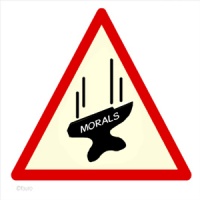

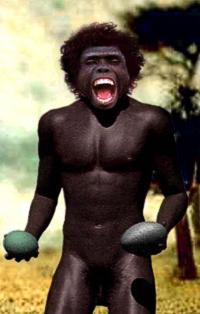 The people who lived there most likely looked a bit like the fellow in that picture. We call folks like him Homo Erectus, and around 1,000,000 years ago our ancestors almost certainly looked a bit like that.