Showing posts with label imagination. Show all posts

Thursday, January 16, 2014

NO! Don't Shoo... - - - GLIPNARF!!!!

Writing a post for another blog, A Catholic Citizen in America, my mind took me off on an tangent. Nothing unusual there.

It's almost on-topic for that post, but not quite: and the excerpt is a better fit with this blog.

Airman AB Glipnarf's Big Mistake

One of the very few 'UFO' reports that I think could plausibly involve extraterrestrial intelligence happened in northwestern Minnesota in 1979.

No, I do not think this is proof that We Are Not Alone: but the report is intriguing.

As a writer, I can imagine a story from the point of view of the space aliens: deputy sheriff Johnson could have startled the jittery crew of a vessel, maybe one that wasn't supposed to land in the first place. The alien equivalent of an Air Force AB shot at the patrol car before the commander could stop him/her/it: making a bad situation much worse.

What happens to Airman AB Glipnarf may depend on how many forms the commander needs to fill out; and whether the landing was the result of equipment failure, botched navigation, or something else.

Now I really should get back to work.

Vaguely-related posts:

Friday, August 20, 2010

A Not-Entirely-Misspent Afternoon

I've been spending a moderately productive afternoon in the attic: reading, relaxing, reviewing notes on a story that's starting to almost make sense; and letting my mind off the leash.

That last is an exercise that can have interesting, sometimes entertaining, and occasionally useful results.

On the other hand, occasionally not-so-useful results.

As I was getting toward the bottom of the thermos of coffee I'd taken up with me, I remembered that I had a Loonfoot Falls Chronicle-Gazette column to write. That's 250 words for a fictional newspaper in an equally fictional small town. Sort of like Garrson Keillor's Lake Wobegon: except that I actually life in a place like that.

Where was I? Remembering that I had a deadline coming up. Right.

While mulling over my weekly challenge of finding something to write about for that nonexistent small town's imaginary newspaper, this phrase dropped onto the front desk of my mind:

"Loonfoot Falls and eight tiny reindeer."

In the context of what I'd been reading a couple hours earlier, that almost made sense - in a convoluted, quasi-metaphoric way.

I think.

On the other hand, aside from that aphasic glow of self-satisfaction I experience when cool phrases fall out of whatever bit of cognitive ductwork they've been lurking in, there didn't seem to be much I could do with that conjunction of ideas.

Besides, I was starting to feel hot and in need of dealing with all that coffee. Which, eventually, led me back here to my place by a north window.

And I still don't know what I'll do about Loonfoot Falls today.

Thursday, July 1, 2010

Well, That's Interesting: Claytronics

One of my daughters is 'way ahead of me. I've started to write quite a few stories, she's finished so many that I've lost count.

Which is fine by me: her example may get me fired up to actually finish one of my bright ideas.

Years ago, I jotted down a few notes about a nifty far-future technology: material that could form itself into many different shapes. It's not a particularly new idea. The heavy in one of the Terminator was 'living metal.' Extremely mutable creatures and devices are an old gimmick in science fiction - including a sort of assassin robot that disguises itself as a section of floor to let an unsuspecting guard walk over it. Just like in Terminator 2: where the scene is such a close match to the old story that I have to assume that it's a tribute.

I'd give title and author of the story - but, despite cudgeling my mind: I can't recall. Mars is involved, as I recall - but that doesn't narrow the field by much.

With my luck, I'll remember at 3:00 a.m. and get jerked awake by the part of my brain that was in 'search' mode.

Wrenching myself back on-topic.

My contribution to the notion of mutable technology, if I'd gotten past the note-making stage, would have been using it for control interfaces. The idea was to have a slab of material that could be, as needed, a keyboard, a control yoke, tuning knobs, whatever.

Which I assumed - this was around the turn of the century - would be a hundred or so years out.

So, Tuesday, I read about claytronics:Among the applications for this still-in-the-concept-stage technology: control systems.

I really doubt that it'll take a century to get claytronics ready for consumer tech.

A decade, maybe.

This is hardly an original thought: but one of the challenges for creators of speculative fiction is to imagine 'future technology' that won't be available in department stores in a year or two.

Sunday, March 28, 2010

Getting Serious by Getting Silly: Meet Galaxy Cadet Aster Alpha

I've decided to get serious about the graphics side of story-telling this weekend: so I played with DAZ Productions Bryce. I've found that I learn more, faster, when I've got a picture of what sort of result I want in my mind and the excellence or lack thereof of the result is relatively unimportant.

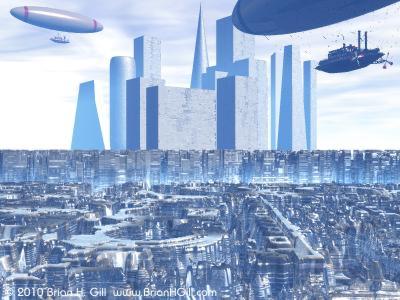
In this case, I wanted a cityscape, seen from the air, with vast acreages of big buildings and other structures in the middle distance: and 'good grief, how big are they' buildings behind them.

Here's what I got:


The 'foreground' structures are from the Rigel Orionis Megalopolis product. Those weird airships are the Bryce Flying Steamer. My oldest daughter tells me that they're done in the 'steam punk' style. I created what's on the horizon in Bryce.

That picture isn't related to any story or setting I'm working on. The flying steamers are - sort of - but that's still pretty vague.

So, why bother? I need to re-learn how to use Bryce - and how to make more effective use of it - if I'm going to make quite a few of my projects work. Putting that picture together helped. Quite a bit.

Getting Serious About Being Silly

Galaxy Cadet (Heroics and Hairspray in the 27th century) is a project that's been on the back burner for years.


Baum Media Productions is a fictional company - part of Loonfoot Falls' world. (Loonfoot Falls Chronicle-Gazette features a 250-word column from the equally fictional town paper each week.)

I don't have the resources to do what BMP did - create feature-length animated Galaxy Cadet movies - but I think I can have a shot at writing stories about Galaxy Cadet. Her name's Aster Alpha, by the way, and after a brief but spectacular mission on the Stellar Guard carrier Wotan, she's been assigned to the fringe patrol ship Albatross.

That was the most remote, obscure, isolated, dead-end spot they could find. And yes: there's a story behind that.


That's Aster Alpha again. I have no idea where that picture was taken. Some sort of planetside port facility, apparently.

If those names don't sound like the sort of terribly serious stuff I've been talking about - you're right. I think I need to loosen up a bit: and following Galaxy Cadet's career may be a good way to do that.

Related posts:

Friday, March 12, 2010

Interstellar Empires, Imagination, and an Occasionally-Sozzled Detective

I suspect that there's a bit of megalomania in many writers of science fiction/speculative fiction. Or should be.

Think about it: your typical detective novel writer writes about people who live in the contemporary culture. If the story is set in, say, Chicago, the author may want to do a little research. It'd be embarrassing to write a story that takes place in Chicago's Rockefeller Center. There's a Rockefeller Chapel at the University of Chicago, but the place with the skating rink is in the Big Apple.

Any story written in a contemporary setting, though, involves at most elaborating on, or re-imagining, an existing locale: and then providing characters whose job descriptions are in the Dictionary of Occupational Titles.

It's not that stories set in a close analog to the world we all live in aren't imaginative. On the other hand, their settings are largely off-the-shelf material.

Which may be why the settings of so many science fiction/fantasy/whatever stories are so - familiar. Sometimes there's good reason for having the action of a speculative fiction setting take place in a world where people go to shopping malls, get stuck in rush hour traffic, and watch television.

For example, the animated series, "Ghost in the Shell," is set in the 'day after tomorrow.' Well, not quite: but we're very close to having quite a bit of the technology. Cultures haven't changed all that much by the time of "Ghost in the Shell." Which shouldn't be much of a surprise: thing's have changed a bit in the last, say, 50 years. On the other hand, styles notwithstanding, we're wearing pretty much the same sort of clothing: and even using many of the same buildings.

While I'm thinking of it, related posts in another blog:

Tales of the Far Future and Galactic Exploration

I started out with megalomania. That's "a psychological state characterized by delusions of grandeur". (Princeton's WordNet)

Maybe not exactly the idea I had in mind - but that term's close. Someone who's serious about writing speculative fiction/science fiction somewhere past 'the day after tomorrow' and this Earth of ours is making the tacit assumption that he, she, or they have what it takes to imagine a complex, internally-consistent universe. That'll probably involve at least a few items from this list:
  • Humans who aren't quite like us
  • People who aren't human at all
  • Jobs that don't exist today
  • Ditto economic and political systems
  • Worlds with life
    • As we know it
    • As we don't know it
    • As we don't recognize it
      • Until we start messing with something it's interested in
"Delusions of grandeur?" Maybe.

But that's what I'm having a shot at doing.

It may help, if I don't take myself - or what I'm writing - too seriously. Two gifted (my opinion) cartoonists wrote - and have re-issued - a series of comic books about an alcoholic detective who's down on his luck: in the early stories, anyway.

Sound almost drearily familiar? It's a sequence of detective stories - pretty much - set in a vast interstellar civilization with weird-looking aliens by the bushel.

I don't think the Foglios intended Buck Godot - zap gun for hire to be taken very seriously.

On the other hand, they put more thought into their setting than I suspect many dreadfully earnest authors did. Two excerpts from a sequence of text sections of the Buck Godot cycle:
"...Even so, one of the real reasons races stay is the realization that there are wonderful things to be learned from those other races, even those annoying fellows with entirely too many ears. Things that, once explained, one can do ones self for free. To be sure, this annoys some of the races that have brought some of these wonderful ideas to the Galaxy's notice; such as the Choaten, who tried and failed to patent the concept of blue as a source of nutrition. Happily, most races realize that since there are more of 'Them' throwing ideas around than there are of 'Us', you tend to get more out of it than you brought into it. This is a universal concept that appeals to everybody...."
Buck Godot - zap gun for hire (January 3, 2008)
Hats off: There's a certain appreciation for the long-term benefits of trade here. In some settings, freely sharing the knowledge your ancestors collected and developed over generations is not being altruistic. Not if other people are doing the same thing.

Getting a meeting ground like that started might be a challenge. Once started, though, I think it'd be so mutually rewarding that most members would pitch in to keep the intellectual 'free lunch' coming.

That business of "blue as a source of nutrition"? Maybe it's just silliness. On the other hand, blue is one of the wavelengths that plants absorb to feed themselves. "Plants" have stayed put and photosynthesized while "animals" moved around and ate plants - and other animals - for the last few hundred million years here on Earth.

But I don't see why that has to be the way to run life. For that matter, I photosynthesize a small but important chemical component in my biochemistry. If you're human, you do too: vitamin D.

Odds are very good that's why my ancestors were so melanin-deficient. They lived in a part of the world where for months at a stretch they'd do well to get sunlight on their face for a few minutes each day.

I'm getting off-topic again.

Writing about these 'trade' centers:
"...these are primarily organizations dedicated to promoting communications, and the vast majority of sentients cannot directly communicate with each other. Some species operate on different time lines, or are out of phase with the four dimensions we can perceive, are too small or too large or, if they had to acknowledge us, they would have to kill us. So even when an atomic matrix life form that feeds off the microwave hum left over from the Big Bang and excretes time lines is in the same solar system with your typical silicon-based life form that eats rocks and excretes hydrogen, communication between the two may be close to impossible...."
Buck Godot - zap gun for hire (March 19, 2009)
Hats off again. Again, I'm not so sure how serious the Foglios were: but they were thinking about what forms people might have - and be 'people' in a reasonable sense of the word.

Good grief. I've set a comic book about an inebriate detective as my standard of excellence.

Vaguely-related posts:

Monday, March 8, 2010

Dinosaurs, Ancient Astronauts, and All That

Mix dinosaurs, ancient astronauts, a dash of paleontology and a handful of imagination. Shake well. It's been done before, but the K-T boundary has been in the news again.

Besides, I haven't got much else to write about today: and I'm scheduled to post something on this blog today.

The Chicxulub Consensus May Not Last Long

First, the news and background, all from Space.com:More background:Excerpt:
"A mysterious basin off the coast of India could be the largest, multi-ringed impact crater the world has ever seen. And if a new study is right, it may have been responsible for killing the dinosaurs off 65 million years ago.

"Sankar Chatterjee of Texas Tech University and a team of researchers took a close look at the massive Shiva basin, a submerged depression west of India that is intensely mined for its oil and gas resources. Some complex craters are among the most productive hydrocarbon sites on the planet. Chatterjee will present his research at this month's Annual Meeting of the Geological Society of America in Portland, Oregon.

" 'If we are right, this is the largest crater known on our planet,' Chatterjee said. 'A bolide of this size, perhaps 40 kilometers (25 miles) in diameter creates its own tectonics.'

"By contrast, the object that struck the Yucatan Peninsula, and is commonly thought to have killed the dinosaurs was between 8 and 10 kilometers (5 and 6.2 miles) wide...."
(Geology Times (October 17, 2009))
It's early days, but my guess is that that international consensus reported in Space.com (March 4, 2010) is already starting to fray around the edges. That's not a criticism: We've known about the Chicxulub event for decades, and this Shiva crater seems to be a relatively new find.

What jumped out at me was the apparent coincidence: Two major impact events happening almost simultaneously (maybe), on the geologic time scale.

Let's say that the a five-mile wide hunk of rock, and another one 25 miles across hit Earth at almost the same time - on a historic time scale.

When All Else Fails, Throw Rocks

Dinosaurs and the other big critters on Earth, 65,000,000-plus years ago, don't seem to have been as consistently dim-witted as we once imagined them: But I think it'd snap the willing suspension of disbelief to write a story where they were as smart as we are. Not if the story was supposed to be even vaguely serious.

I'm about as certain as I can be that whatever long shot may have happened when the K-T boundary was created was a natural event.

On the other hand, what if it wasn't.

I know: It's been done. In a Dr. Who two-parter, "Earthshock" (1982), for example. That time the blast was caused by a spaceship hitting Earth.

There are many other options, of course.

Let's try this on for size:

The war had begun long before. Neither side was willing - or able - to surrender. And neither side had a significant advantage over the other: hardly surprising, as they were both descended from the same people. Not that either side's leaders would admit that this was the case.

They had established rules of conduct for the conflict. Both had found that people - intelligent races - were a rare phenomenon. Both believed that intelligence was important, although they differed on how it should be applied.

And so they agreed that their war would not be a threat to any people they might find.

Each side were, in their own way, quite ethical.

Which made the current situation so revolting.

A warm, damp planet had recently been found. It was virtually useless to both sides: The climate was not within their comfort range, and lacked the aesthetic appeal they demanded of their homes.

Besides, even if they had wanted to do so, neither side could settle there. An exploration team had found - not people, but creatures which showed great promise of developing intelligence.

So the planet was declared off limits.

The star this planet circled, however, was ideally positioned for one side to use as a - let's call it a "listening post." Such an installation could easily be placed in orbit around any of the star's planets, or in orbit around the star itself.

Instead, they built installations on a planet. The warm, damp one. Two installations, actually, near the equator but on opposite sides of the planet.

This was a brazen violation of a long-standing agreement: but the installations remained. They had been made self-sufficient, and so blockade was out of the question. They had defenses which were more than adequate to repel the largest force that their enemy could mount.

And the installations were gathering valuable information, which could easily break the long stalemate.

Something had to be done.

Finally, in desperation, the side which was now losing assembled a vast fleet and took control of the space around the damp planet's star. Then diverted two asteroids toward the damp planet, after mounting a formidable defense system on both.

The two installations could have destroyed any missiles directed against them, and were effectively protected from directed-energy weapons by the damp planet's atmosphere, and their own shielding.

The designers of the installations had even built adaptive intelligence into their defenses, so that as the enemy developed more sophisticated weapon systems, the installations could develop more sophisticated defenses.

The designers had not foreseen that the enemy would throw large rocks.

The larger of the two projectiles was already blasting a crater in the planet's surface while its remaining defenses, on the 'upper' side, were neutralizing a formation of missiles directed on its smaller companion.

Both installations were destroyed, of course.

The war ended not long after.

A few research teams returned to the damp planet. Most of the species which their predecessors had cataloged were gone. The researchers studied what was left, made their reports, and moved on to other tasks.

After a while the researchers stopped coming. Some life remained on the planet, small scurrying things which had somehow survived the twin cataclysms: but the species which had shown so much promise was gone, along with - as far as the researchers could tell - all similar creatures.

New creatures emerged, and changed as the damp planet turned cold. Several species of strange animals which could grasp branches with all four feet developed. One of these moved out of the forest, walking on its rear hands: which had lost most of their grasping function.

In time the descendants of this species chipped Troodon fossils out of rocks which had been sand and mud when incandescent waves of rock engulfed lands around the now-forgotten installations.

Okay: It's Not Shakespeare

Troodons were smart, sort of: probably about as bright as an ostrich. And they had hands. Again, sort of.

No, I do not think they were people. But there could be people built along the same general lines. We might find that we're the oddballs among this galaxy's races.

Assuming that there are any besides us, of course.

Which is another topic.

Wednesday, December 9, 2009

'All We Want is Peace and Quiet' - Another Look at the Mind of the Alien

A post on someone else's blog caught my eye today:
Apart from the occasional grammatical oddity and a few spellchecker howlers, it's a well-written general guide for horse owners.

The part that's relevant to this blog is the section headed "Herd Mentality:" discussing the way horses think.

They're not human.

Faced with danger, horses run.

Faced with danger, or something we don't like, we're likely to do what most primates do: scream and start throwing things. (Ever see news video of a violent mob?)

Horses like things to be quiet.

Not everybody's as noisy as Americans — and, I understand, Australians. But one thing that human beings are not is quiet. Not compared with most creatures.

I admire horses, but haven't had that much experience with them. I grew up with cats, so I can read their expressions pretty well, and can generally communicate with them fairly well. Nothing complicated, of course: more the 'I'm not threatening you' sort of thing.

Dogs? I read them fairly well, and get along with quite a few individuals - largely, I suspect, because of what we did to their distant ancestors.

What cats, dogs, and apparently horses, have in come is that, although we can communicate with them, they're not human. They don't respond to their world in quite the same way we do.

From a science/speculative fiction writer's point of view, that short section on herd mentality might get ideas going for how to 'build' non-human people.

Sure, on Earth the people are screaming, stuff-throwing primates: but that doesn't mean that's the only way things can work.

Sunday, November 22, 2009

Humanity Is Not the Eldest

There isn't much to this post, apart from the following link: That page actually doesn't have all that much to do with television science fiction and fantasy: a great many examples are from written literature.

Still: interesting material, including
  • "The Hitchhiker's Guide To The Galaxy"
    (Douglas Adams)
  • The "Marvel Universe"
  • The "Known Space" stories
    (Larry Niven)
  • "Gateway"
    (Frederik Pohl)
And, of course, H. P. Lovecraft's Cthulhu and that merry band of "Old Ones" in the Cthulhu Mythos.

Which reminds me of what I wrote, toward the end of "A Sense of Scale and Science Fiction Writers" (August 17, 2009) (Getting Imaginative): Maybe H. P. Lovecraft was an optimist.

Saturday, July 25, 2009

Hard Science: It's Not Necessarily a Limitation

Science fiction, or 'speculative fiction,' to use a more current term, would seem to be easier for a writer to handle if he or she doesn't bother with 'hard science' - that is, what we know today about how the universe works.

In a way, that's true. The Andre Norton stories, for example, often had science-fictionish accouterments like starships and blasters - but the author didn't bother with serious science: apart from generally seeing to it that things fell down, rather than sideways, for example.

Quite engaging stories can be written with a blithe indifference to quarks, specific heat, or tensile strength.

But, I think sometimes knowing a little science can help.

Take interstellar spaceships, for example.

Just Make it Look Cool

We're pretty familiar with the Star Trek or Star Wars approach: make a model that looks cool, and go with that. No problem: it works in the movies, and in written fiction.

But, there's something to be said with sticking with science as we have it.

Although there are some really promising theoretical possibilities on the horizon, involving aggressive warping of space-time, we probably won't be seeing 'warp drives' any time soon. In another blog, I opined that, depending on how you looked at current knowledge and technology compared to milestones in rocket technology and orbital mechanics, we might be anywhere from fifty to two thousand years away from having a practical 'warp drive.' (May 7, 2009)

But, that's wild guesswork at best.

Take Current Science and Technology, Add Imagination

There are quite a few might-work ideas out there, including light sails pushed by titanic laser arrays. Many of these have the advantage of both being something that might, plausibly, work - and having specific requirements that restrict what a vehicle would look like, and how it would perform.

That's not necessarily a bad thing. While it might be cool to imagine a spaceship shaped like, say, a teddy bear or a tennis racket, I think the appeal might fade a bit after a few chapters.

I went digging in my notes today, and found a design that isn't all that different from the rockets we use for space travel today.
Steam-Powered Space Ships?!
A philosopher in ancient Greece, Archytas of Tarentum, made what may be the first rocket-propelled vehicle about twenty three centuries back. It was a model bird, suspended from a ceiling, with a container of water and a heat source inside. The water turned to steam, shot out the back of the bird, and made the thing swing around, 'flying.'

Don't knock it: the gadget may have been a blast at parties. But it wasn't of much practical use.

Fast-forward a few centuries, and you get to Hero of Alexandria's aeolipile. It shot steam out of two nozzles , rotating a sphere. Quite an accomplishment: but there wasn't an effective method for getting work done with steam until the 1700s.

Gunpowder was developed in China, maybe as early as 850, and possibly as a spin-off from other research.

It would be possible to have a steam-powered space ship, provided there was a way to get the steam hot enough. Steam rocket engines have been built: one was used in the 1960s as the engine of a drag racer.

The idea of an atomic rocket - a vehicle using a nuclear reactor to heat water or some other liquid and squirt the resulting gas out a nozzle to produce thrust - is decades old, and will probably be done some day.

But, since there are limits on how fast the gas can be pushed out, even an 'atomic rocket' probably wouldn't be practical for an interstellar space ship. The problem is that a rocket's performance is linked to how fast it can push stuff off the vehicle - how fast its exhaust is.

And no, it's not that 'a rocket can't go faster than its exhaust.'

On the other hand, in the case of rockets: Faster is generally better when it comes to exhaust.
Beamed Core Antimatter Drive: Better Than a Steam-Powered Space Ship
The fastest that matter or energy can travel is the speed of light. Actually, there may be some work-arounds for that - but that's the sort of 'warp technology' that we aren't even close to having. Probably.

For rockets, the ideal would be to have an exhaust velocity around speed-of-light.

There are a few ways to do that. One is to get duct tape and attach an ordinary flashlight to your ship. Turn on the flashlight, and photons shooting out at speed-of-light will produce thrust. Not enough to measure, let alone move anything significant: but it does produce thrust.

Another is to use a beamed core antimatter drive.

We don't, quite, have the technology to build one: but we're very close. The beamed core antimatter drive is described on a website associated with the University of Alaska-Fairbanks, along with some other rather theoretical ways of getting to the stars.

This particular 'star drive' uses protons and anti-protons for fuel. They're brought together, annihilate each other, and then things get interesting:
"...Protons and Antiprotons are injected into the magnetic nozzle, where they collide and annihilate producing a collection of pions. The uncharged pions are unaffected by the magnetic field and fly off, almost immediately decaying into gamma rays. These gamma rays would have to be stopped by some sort of high-density shielding. The charged pions shoot down the magnetic nozzle at what is essentially light speed, after traveling a distance of 21 meters in 70 nanoseconds, they decay into muons and neutrinos. The muons are longer lived, they travel 1.85 kilometers in 6.2 microseconds (99.5% light speed) before decaying into electrons and positrons (and more neutrinos). As you may be aware, the performance of a rocket is mainly limited by its exhaust velocity. The Beamed core drive would have an exhaust velocity of near light-speed. Allowing (with sufficient amounts of antimatter) acceleration up to almost any arbitrary percentage of the speed of light...."
(Beamed Core Antimatter Drive)
There are some huge engineering issues to be resolved before anything like this can be done. A few particle accelerators have been set up to sort out protons and anti-protons, and store the things in very tiny quantities: but something like this would need tons of both. And this is a case where you definitely do not want to be anywhere near a fuel spill.

Also, we don't have the magnetic containment devices that would be needed. Superconducting magnets may be the route to go on this and (somewhat) high-temperature superconductors are around now.

So: What Would a Starship With a Beamed Core Antimatter Drive Look Like?

The drive itself would be huge. Besides whatever is used to contain the protons and anti-protons, there's the reaction chamber, then a 21-meter-long section to contain and direct positive and negative pions, and finally a 1.85-kilometer-long section that contains and directs positive and negative muons. After that, a stream of electrons and positrons, plus neutrinos, shoots off into space, pushing the ship in the opposite direction.

The engine, because of how fast the exhaust particles travel and how rapidly they break down, would have to be 1.871 kilometers long, plus the reaction chamber - or, in English units, a tad under a mile and a quarter long.

If built, it might be mostly an open framework holding coils, rings, or whatever geometry is required to generate the magnetic fields.

Impressive, I think. Add a plausible-looking set of containment vessels for the fuel, habitats for the crew, cargo modules, and you've got a whacking great starship: based on a bit of science and a bit of imagination.

Related posts: Background:

Privacy Policy

Nothing spooky here.

These days it's important to have a "privacy policy" available: so here's mine.

I do not collect information on individuals visiting this blog. If you leave a comment, I'll read what you wrote: but I don't keep a record of comments, apart from what Blogger displays. (In other words, the only record of what you write or who you are will be what people see at the bottom of the post.)

I do collect information about how many hits this blog gets, where they come from, and some technical information. I use the WebSTAT service for this purpose - and all that shows is which ISP you use, and where it's located.

You can stop most of Webstat's data gathering by disabling cookies in your browser. I don't know why you would, but some folks do.

I'm also an AdSense affiliate, so Google collects information on what I've written in each post: but that's mostly my problem.

I'm also considering starting an affiliate relationship with DAZ Productions. You should be able to keep DAZ and Commission Junction, their provider of affiliate services, from collecting information by - again - disabling cookies in your browser.

And you can keep DAZ Productions from finding out anything about you, by not buying any of their products.

Again, I don't know why you would: but some folks do.

Or, rather, don't.